
Purdue SuperCam helping with Mars research
Subscriber Benefit
As a subscriber you can listen to articles at work, in the car, or while you work out. Subscribe NowPurdue University alumnus Neil Armstrong was the first human on the moon, and decades later, a Purdue professor is playing a key role in cracking the code on a planet 140 million miles away from Earth.
Roger Wiens is a professor of planetary science and leads the SuperCam instrument team. SuperCam is marking its fourth year on Mars and is part of the Perseverance rover.
The instrument uses lasers and infrared cameras to figure out what rocks on Mars are made of and how they have been shaped over time.
“We are curious about Mars because it represents a capsule in time. A lot of what happened on Mars happened a long time ago, and the surface has not really been disturbed much since,” Wiens said. “[Our work] includes not only studying Mars, but also picking these best samples to bring back to Earth someday.”
The SuperCam has gathered half a million images to help scientists better understand how unique rocks make up the planet. Researchers are searching for signs of ancient microbial life and studying habitability.
“Here were some of these very white rocks, and so we started shooting them with the laser. Lo and behold we were shocked; they had a composition that was all aluminum and silicone. This is very unusual,” Wiens said. “This is very unusual…we started to realize that these are very altered rocks; they have been through a lot of water on the surface of Mars. This is something new we had never seen before on Mars.”
According to NASA, the SuperCam can identify the chemical and mineral makeup of areas on Mars as small as a pencil point from a distance of more than 20 feet.
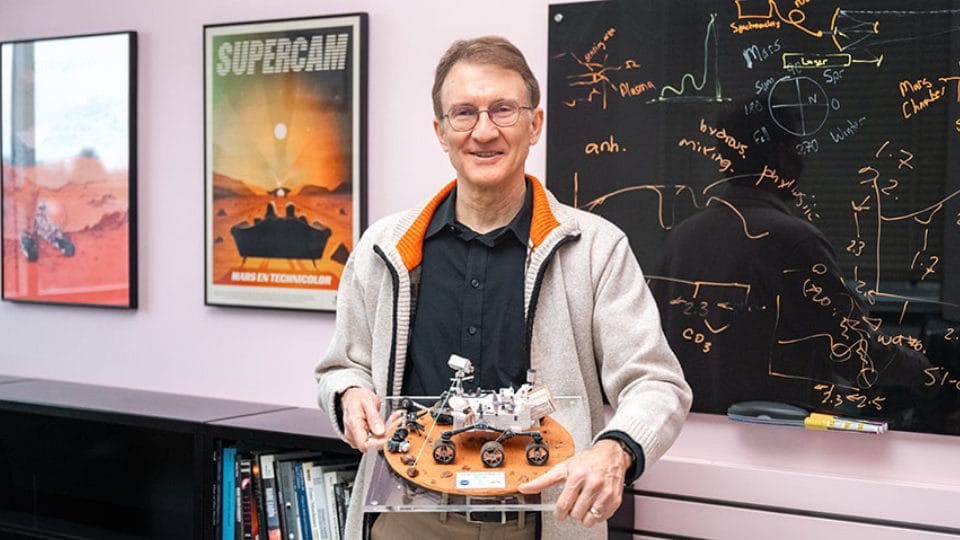
Wiens just received the 2024 Herbert Newby McCoy Award for his work advancing Mars research. The award is Purdue’s highest honor for contributions to the natural sciences.
“Roger Wiens’ research has transformed planetary exploration, setting new standards for space instrumentation,” said Guang Lin, associate dean of research and innovation in the College of Science and chair of the McCoy Award selection committee. “His contributions to the Mars rover missions have provided critical insights into the planet’s geological history and potential for past life.”
To read more about Wiens and his work, click here.