
While Jacob Perkins is the Midwest K-12 education manager at Jeffersonville-based manufacturer Amatrol Inc., he is making an impact nationwide. In his role, Perkins works in 15 states across the Midwest, Mid Atlantic and Florida.
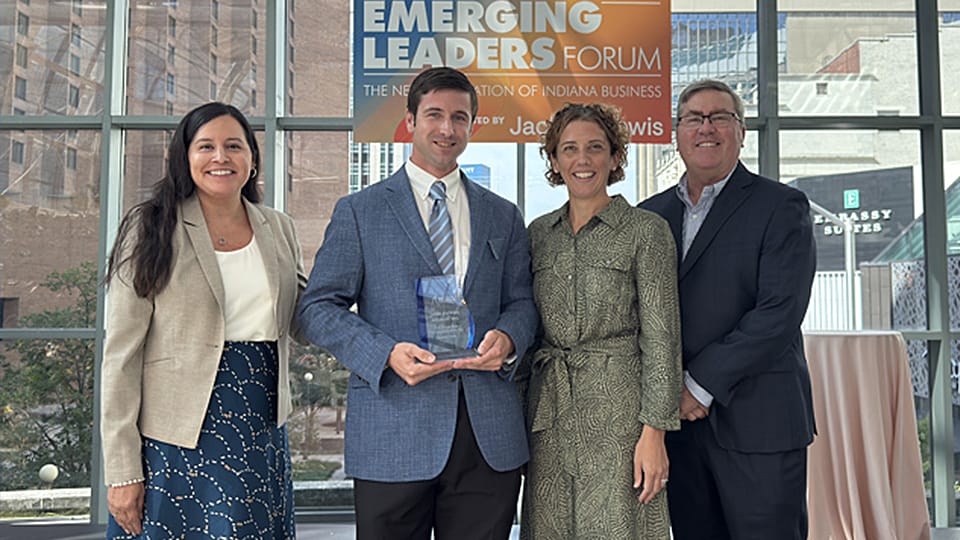
Earlier this month, he was honored with the Indiana Chamber’s first-ever Emerging Leader of the Year award.
Perkins spoke with Inside INdiana Business about his career, the state of education and workforce development and more.
This interview has been edited for brevity and clarity.
How long have you worked at Amatrol?
I’ve been at Amatrol for nearly 10 years, and I’ve worked in several different positions. After working in manufacturing, I’ve most recently transitioned into education development for K-12, so that includes career centers and high schools. I work with our distributors to help develop world-class high school education programs which tie into state pathways, industry-recognized credentials and meet graduation requirements.
Within our learning management system, we have about 5,000 hours of online content in both English and Spanish. It covers safety, electrical, plumbing and HVAC, and it’s all broken down into these modules that are on specific topics.
What drew you to the education role from the role you previously had?
Part of it was that I like to travel, and I’m always traveling now. It can be tough at times, but it is interesting to get out and see all of these different high schools and career centers in these different states. I get to work closely with instructors at a lot of these schools and administrators, and I like doing that and being able to work through challenges.
It’s very similar a lot of ways to engineering, but also different. Instead of working on products, you’re really trying to help solve organizational or program challenges. It’s an important mission because we’re helping with career and technical education (CTE), and right now CTE is front and center in in education. We know we need skilled trades, whether it’s in construction, automation, robotics, manufacturing, etc.
How has the focus on workforce development changed among high schools and career centers compared to when you were in school?
It’s changed a lot in several ways. It’s become a stronger focus for the entire secondary education system. I recall when I was growing up, it was always said that you have to go to a four-year university or obtain a much higher level of education to be successful in careers. What has been determined is that’s not necessarily true in a lot of careers, such as manufacturing, construction, HVAC, electrical and plumbing. Having a industry recognized credential, having a two-year associate degree through your local community college or having some sort of work-based learning experience can equip workers very well for those careers.
In most of the schools I go into now, they realize if they’re not doing CTE, or if they’re trying to enhance their existing programs, it’s an area that they need to invest heavily in not only with resources, but their time and effort.
I remember when I went to school, CTE was always kind of related to shop class, where you’re going to do woodworking or something really basic like that. Now, in a lot of the high school and career center programs, which are still fairly at an entry to mid-level, we’re seeing students working on complex automation and robotic systems. Now we’re getting into AI, and high school students are having to figure out how to collect and analyze all this data like they will have to do in their in their prospective career.
Why is it so important for you to introduce some of these concepts and these career options to middle and high school students like before they graduate?
The number one reason is that our youth are going to be our future workforce. Whether they decide to directly enter the workforce, go on to a community college or four year university, they are going to need to have some of these foundation level skills—from the key employability skills like math, science and communication to specific skills in their field.
If they’re starting after high school, it’s too late for many reasons. We want to get them interested in it early, because a big part of this process is not just figuring out what you what you want to do, but also what you don’t want to do. Hopefully students can figure that out in middle school, and as they’re going into high school, so they can create a plan to either directly enter the workforce or explore postsecondary opportunities. That gives these students a better chance to succeed in these programs and in in their careers.
Do you have any success stories you can share?
In the 15 states I cover, one school that really stands out is Angola High School in northeast Indiana. The instructor there is Jim Savage, and he is running an Industry 4.0 program, which deals with smart devices and interconnected systems. The students are going through a four-course program, starting off with the fundamentals. At the end, they’re getting into IoT, data analytics and networking.
The first time I met Jim, he had not been teaching this class, and they didn’t have any curriculum or equipment. Over the course of a year, he actually applied for the Conexus Indiana education readiness grant and was able to receive funding to start this new advanced manufacturing program. Since then, he’s had several students not only achieve entry-level certifications, but also very, very advanced levels that we would typically see students obtaining in in a community college or four-year university.
Have the education programs created a talent pipeline for Amatrol?
Yes. Our headquarters manufacturing operation is in Jeffersonville; we have somewhere between 300,000 to 400,000 square feet of manufacturing space and 350 to 400 employees. We pull from career centers such as Prosser Career Education Center in New Albany and also from the local community colleges.
What was it like getting this recognition from the Indiana Chamber? What other organizations are you involved in?
It was a huge surprise, and it means a lot to me and my family, because they’ve been a huge support group. I’m really honored to have received this award and be able to just talk a little bit about what my role is and how I’m trying to help shape education and CTE.
I help with our local chamber of commerce, which is called One Southern Indiana. I’m the youngest chair of their Metro Manufacturing Alliance, which is an organization that helps with connecting manufacturing companies together and helping to foster collaboration in business in the southern Indiana area. I’m part of the Manufacturing Week planning committee and also on their board of directors.
I sit on Conexus Indiana’s Advanced Manufacturing Council and provide input on needs and issues related to advanced manufacturing logistics in the state of Indiana. I also help with the Indiana Occupational Health and Safety Committee (OSHA), overseeing safety variances, such as businesses needing to make changes to a particular process or design to meet safety requirements. I also hear OSHA safety-related cases.