
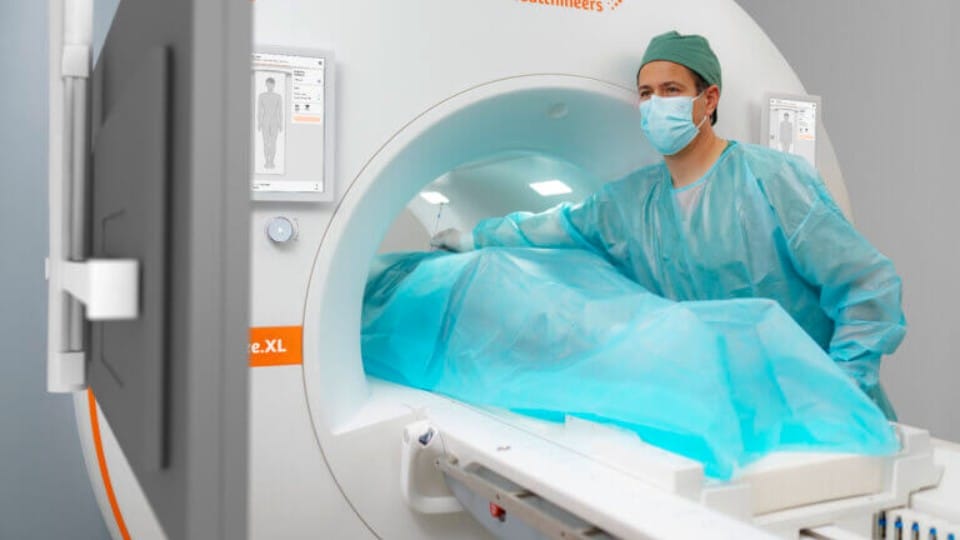
Bloomington-based Cook Medical this month announced a partnership with diagnostic imaging giant Siemens Healthineers to develop medical devices specifically designed for use in interventional magnetic resonance imaging, or iMRI.
The companies are creating the Interventional MRI, or iMRI, Suite, the first integrated, ionizing-radiation-free product to provide clinicians with real-time guidance for procedures requiring delicacy and precision such as interventional oncology for soft tissue tumors, pediatrics and structural heart procedures. Interventional MRI is used for procedures including biopsies or tumor resections.
The iMRI Suite, still in development, is a package of products and services that includes an MRI scanner, MRI-specific medical devices, software, specialized training and clinical support.
The approach, according to Cook and Seimens Healthineers, allows clinicians to use the soft tissue contrasts provided by MRI to navigate complex procedures while eliminating exposure to ionizing radiation for patients and healthcare teams.
Cook is working to develop devices such as needles, wire guides and catheters—a challenging task for use with MRI machines since the materials must be able to be used in magnetic environments.
Peter Polverini, vice president of Cook’s Interventional MRI division, said the partnership grew out of collaboration in research between Cook and Siemens and the National Institutes of Health.
“The NIH was working with us and they were working with Siemens and they said, ‘you two should probably connect, because you guys have the same vision,’” he said.
Siemens Healthineers, based in Germany, is a leader in MRI technologies and services.
“MRI in the interventional suite has always been a concept with tremendous clinical potential, but it has also faced significant barriers,” Andreas Schneck, head of magnetic resonance at Siemens Healthineers, said in a written statement. “Together with Cook Medical, we’re leading the way into a new era where iMRI becomes a precise radiation-free standard of care.”
The agreement with Siemens Healthineers comes less than two months after Cook announced in July it had created a new iMRI division, citing the need for devices compatible with the growing use of interventional MRI.
Cook’s Polverini said the partnership requires significant innovation.
“We basically take that stainless steel needle and we put a very different type of metal, an Elgiloy, together and we basically make sure that it’s nonmagnetic, which means it won’t heat up in the magnet,” Polverini said.
He added that the devices are used in conjunction with artificial intelligence.
“And then we mark it in a very specific way that the AI of that software picks up that needle marker,” said Polverini, adding that the software and AI are taking and overlapping images in real time for high precision for a physician accessing a tumor with just a 5 mm target, for example.
Cook did not disclose how much the iMRI Suite would cost customers. The joint Interventional MRI Suite is under development and not available for sale in the United States, the companies said.