
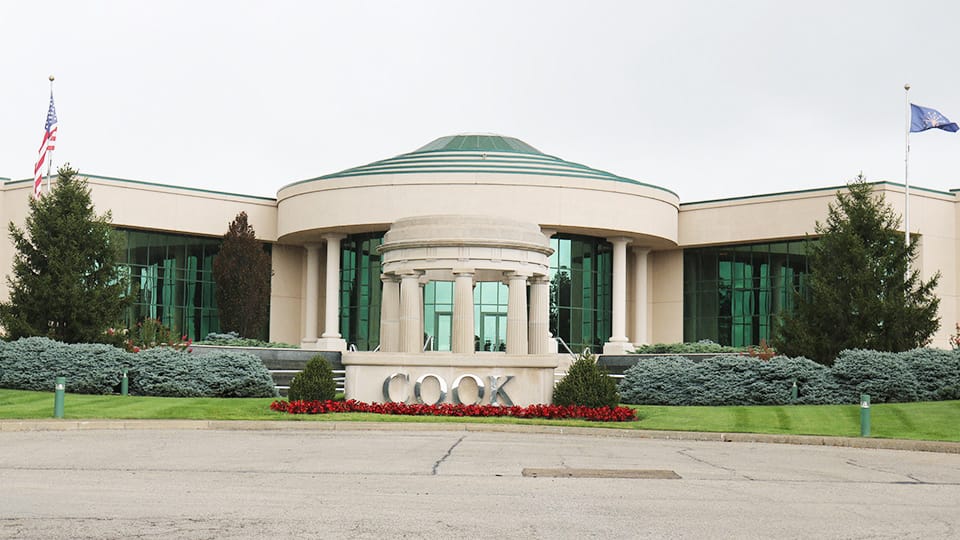
Bloomington-based Cook Medical has launched a new division it says will mark a significant step in transforming how complex medical procedures and unmet clinical needs are met.
The Interventional Magnetic Resonance Imaging, or iMRI, division involves the development of a portfolio of minimally invasive devices that can be used to better treat patients in MRI environments, particularly in oncology and pediatric cardiology.
Peter Polverini, who was named vice president of the new division, says interventional MRI takes the conventional diagnostic method of MRI to another level.
“In typical diagnostic [MRI], we’re just taking pictures,” Polverini said. “With interventional MRI, we put the patient inside the bore, we take an image of them, we diagnose them, and then in the immediate response to that diagnosis, we start taking action, and we start intervening in real time.”
In the oncology space, for example, Polverini says if a doctor finds a spot on a patient’s liver, that patient may have to wait for the spot to get to a certain size before a biopsy can be performed. With iMRI tools, that wait time can be negated.
“We’ll go inside the bore of the [MRI machine] and be able to spot those [lesions] and then be able to put a needle into that liver and take a sample of that core,” he said. “Then, we’ll have pathology determine if that’s cancer or not.”
Cook Medical says the new division is partnering with premier companies to create state-of-the-art imaging technology to support iMRI products and then collaborate with physicians, hospitals and other partners to integrate the real-time technology that can reduce the risks associated with repeated exposure to ionizing radiation.
Polverini said the company has been working on interventional MRI for decades, but it hasn’t been until recent years that technology has caught up to be able to address an unmet clinical need.
“We’ve seen imaging accelerate and software accelerate and artificial intelligence in that software accelerate,” he said. “We’ve developed brand new tools that we can really mark in a very special way, so that it can be used in software with artificial intelligence, so that we can do this in real time.”
In addition to oncology, Polverini says the division will also have a focus on pediatric cardiology to support babies with congenital heart issues.
“Those babies have numerous radiation exposure with their congenital heart issues,” he said. “With interventional MRI, we don’t have that same radiation exposure. So we have a lot of hospitals that have been working with us on developing technology in that space for these patients.”
Cook Medical plans to hold a scientific launch of the iMRI division at the CIRSE Annual Congress in Barcelona, Spain. The weeklong event serves as a “platform specialists in minimally invasive image-guided procedures,” according to the event’s website.
Polverini says the iMRI space has the potential to serve as a “paradigm shift” in medicine, particularly when it comes to diagnosing and treating certain cancers.
“The vision could be on the oncology side, a patient gets diagnosed. We take a biopsy in real time and get an answer on whether it’s cancer,” he said. “If it’s cancer, we treat it right there in the lab, and they walk out of the door knowing they had cancer. That’s where we would like to see this go in the next 10 years.”
Cook Medical is a subsidiary of Bloomington-based Cook Group, which is Indiana’s fifth-largest private company, according to IBJ research. The company recorded $2.6 billion in revenue in 2024 and employs more than 13,000 people, including 6,800 in Indiana.