
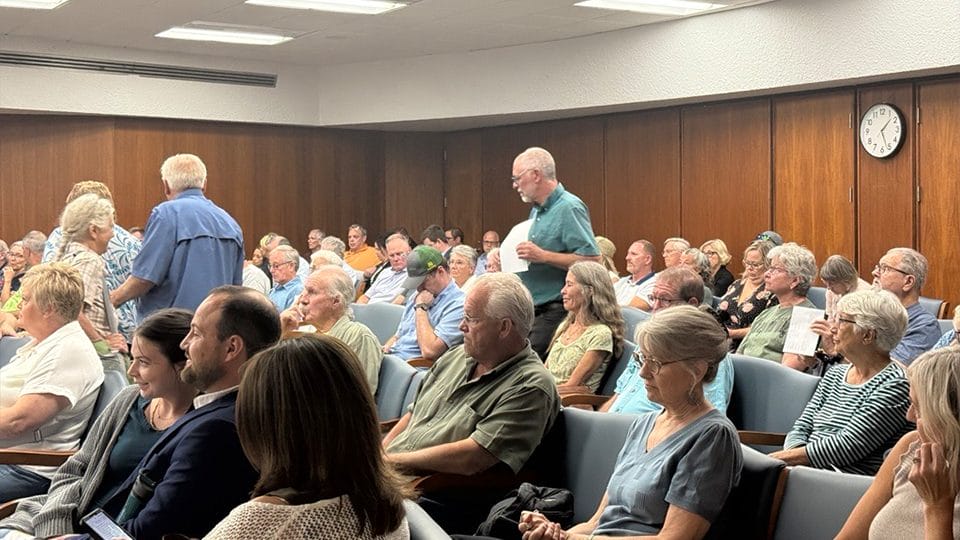
The St. Joseph County Area Plan Commission voted unanimously on Tuesday to give an unfavorable recommendation to rezoning more than 1,000 acres of farmland near New Carlisle for a $12 billion data center project, forwarding the petition to the County Council.
The decision capped nearly four hours of public testimony that highlighted sharp dissent over whether the largest proposed private investment in county history would in fact strengthen the local economy or simply erode farmland, deplete water resources and diminish rural character.
“Industrial rezoning at this location is in conflict with two recently adopted comprehensive plans expressing the future land use desires of the residents of St. Joseph County and the town of New Carlisle,” said Sean Klein, executive director of the Area Plan Commission.
Klein noted that if sewer, water and road upgrades are made to meet county engineering requirements, the site could support future data center development and contribute to the county’s economic growth.
Much of the debate centered on the county’s recently adopted 2045 Comprehensive Plan, which clearly designates the land for agricultural use.
“We spent years and countless hours on that plan,” said DJ Tavernier, the Osceola Town Council representative on the commission. “This is a frustrating conversation. If the comp plan doesn’t matter, what was the point of all that work?”
New Carlisle Town Council Representative Molly Hannon made the motion to reject the rezoning, noting that while developers had pledged to deed 250 acres as a public buffer, that land was already designated as a buffer.
“Our town has been in a battle for a very long time trying to protect and to keep things within a certain area,” Hannon said. “To see the spread again with no trust in the processes that have already happened (is concerning). When you hear all these people talk, there’s very little trust with what’s always presented and what actually comes through.”
New Carlisle resident Mary Fisherman said tossing aside that work would undermine trust in local government and make it harder for businesses or families to plan their futures in St. Joseph County.
“Why would an investor consider building homes or apartments, not knowing if, instead of, for example, a peaceful farm field in the very near future, it could become an industrial zone?” Fisherman asked. “No one wants to live near that.”
The county’s comprehensive plan devotes an entire section to farmland preservation, identifying conservation as a core pillar alongside growth and infrastructure. That section emphasizes protecting land and rural landscapes “best suited for producing crops, pasture, range, forest or agriculture and educational use and enjoyment.”
“Basically, there is not enough lipstick for that pig. I don’t care about how big a buffer zone is. This goes against the county comprehensive plan passed only 308 days ago,” Fisherman said. “It also goes against the New Carlisle plan. If this is allowed, it would be an extreme insult to over 800 people who were asked to work on that plan.”
Fisherman gave public comments on the proposed rezoning to industrial, urging commission members to vote no
The developer’s and landowner’s legal representative, Brandon Dickinson, argued the project was designed with community concerns in mind. The proposed 14-building campus would unfold in two phases, employing about 250 people.
Roughly 700 acres would remain tillable, and Dickinson said the design used “half as much buildings on double the land,” referring to the 30 shells on Amazon Web Services’ $11 billion data center campus that is currently under construction.
He emphasized restrictive covenants and rezoning commitments to limit impacts and told the commission the company had met with New Carlisle officials over the past two weeks to discuss adjustments based on feedback.
“We’ve seen what one data center company is willing to do on the site,” Dickinson said. “We’re just trying to show that we are different than the other developers that the county has interacted with.”
Bill Schalliol, the county’s executive director of economic development, said the county had been in conversation with the still-unnamed developer since December. While the site is outside the Indiana Enterprise Center’s core boundary, Schalliol called it consistent with planning that began in 2017.
“We are just at the zoning stage, the front end of the whole process. They are really wanting to do things that respect the site,” Schalliol said. “We’ve learned a lot from the first data center and we want to be ahead of the curve this time.”
Looking ahead, Schalliol suggested the county may need to pause after a second major data center campus.
“I think we’ll probably hit a point where we’ve run the course with data centers,” he said. “This is something that really has happened over the last three or four years. The next step is positioning ourselves for whatever the next thing is.”
Concern over second data center
Jeff Rea, president and CEO of the South Bend Regional Chamber, said the lack of details had fueled unease over the project.
“I don’t have any information on the data center,” Rea said before the hearing. “That lack of information has people somewhat concerned, just because they don’t know exactly what’s being planned.”
Citing Amazon Web Services and Microsoft, Rea added that past data center projects have brought significant benefits to the county.
“These are large capital investments. It’s a lot of construction jobs during the project,” Rea noted. “On the other end, it’s a good taxpayer. The jobs typically pay 125% of the average county wage.”
For many residents, the project represented too much, too soon. Over 30 people testified against the project. Klein also noted the county received over 140 remonstrance letters.
New Carlisle resident Dan Caruso suggested at least a one-mile setback and a property value guarantee if the commission were to give a favorable response, referencing the requirements county officials recently imposed on solar projects.
“When the Amazon project was presented to us, it was 16 to 18 data centers,” Caruso said. “There is absolutely zero trust with what takes place in this room. Nothing seems to get proof checked.”
Lifelong residents of the area in question gave moving comments about the legacy their homes and farmland represented and desperately urged the commission members to give the petition an unfavorable recommendation.
“We’ve done a lot to establish what we would call lifetime estates or residences that we want to be in forever,” said Chicago Trail resident Ben Hannewyk. “We don’t want to see the area deteriorate because of these types of things. We understand the need for progress, but we don’t relish the idea of having this down the street from us.”
Opponents cited a wide range of issues such as distrust from the first data center project, questions about water usage and waste management. Other concerns included increased traffic and road accidents, light pollution, closed roads and much more.
Kim Burnette of New Carlisle argued the project undermined conservation and the county’s emerging “tech corridor.” Jen Miller said the proposal left her feeling “swallowed,” while Sandra, a nearby resident, asked, “What are we going to eat?” if farmland keeps disappearing.
Steve Shaaf, a representative of Greencroft’s Hamilton Grove, an independent and assisted living facility, said buffering promises rang hollow.
“You cannot buffer the sound. You cannot buffer the artificial light, and you cannot buffer the traffic,” he said. “The development is viewed as incompatible with the quiet, natural, country setting and would undermine the residential quality of life of Hamilton Grove’s residents.”
Others questioned the process. Jan Cervelli of Granger called for changes to nondisclosure agreements between developers and the county. Citing the University of Michigan’s Gerald R. Ford Public Policy Institute, which recently released study on data centers across the country, she also opposed the petition.
“Data centers in their excessive demands of local energy, water and infrastructure drive supply down and prices up,” Cervelli quoted from the report. “Despite claims of job creation, data centers typically generate few permanent positions relative to the scale of public subsidy they receive.”
Excluding county staff, Susan Lewis of New Carlisle was the only person who gave public testimony in support of a favorable recommendation.
“We’re all upset how technology has changed our lives, some for the good, some for the bad, but it’s here to stay,” Lewis said. “What I hope is that we can all work together for the community and keep our environment in the best shape possible.”
For now, the $12 billion data center remains in limbo. Schalliol said St. Joseph County Council will take up the petition Sept. 23 in its Land Use Committee before a final vote on Oct. 14.