
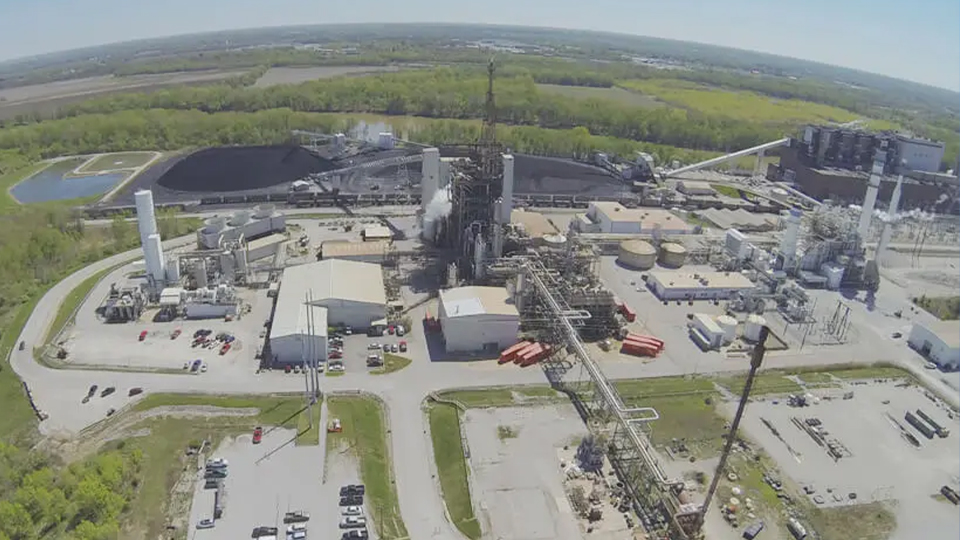
The U.S. Department of Energy announced Wednesday that it has closed on a $1.5 billion loan to Wabash Valley Resources LLC to support its anhydrous ammonia fertilizer operation in West Terre Haute.
The $2.6 billion project, which has been nearly a decade in the making, will repurpose a former coal gasification plant to produce 500,000 metric tons of anhydrous ammonia fertilizer annually.
Greg Zoeller, vice president of external affairs for Wabash Valley Resources, says closing on the loan marks an exciting moment for the long-awaited project.
“A lot of our partners and investors have put a lot into this, and it’s going to be something that they’re proud of in terms of showing their best-in-class technology,” Zoeller told Inside INdiana Business. “Contracts have been signed, but now we can send out a notice to proceed. So that’ll be the first step in utilizing the funds we currently have to start building out.”
The plant is being designed to use petroleum coke, or petcoke, as the primary feedstock to make the anhydrous ammonia fertilizer. Petcoke is a waste product from the refining of gasoline.
Zoeller says about 80% of the feedstock will be petcoke, with the remaining 20% being coal sourced from a local Indiana mine, though the name of the mine has not yet been revealed.
A key component to the project is the use of carbon capture and sequestration. In January 2024, Wabash Valley Resources received permits from the U.S. Environmental Protection Agency to begin construction on two wells in Vermillion and Vigo counties that will be used for the underground storage of carbon dioxide.
Zoeller said the use of carbon capture brings the West Terre Haute plant to its full potential.
“This plant was one of the first to show a clean-coal technology that cleaned up everything except the carbon dioxide,” he said. “Now we take the last step, so there won’t be any of the emissions that were normally associated with either coal, natural gas, petcoke, or any of the other fossil fuels. I think it’s going to be an example of us and American technology, with our partners from around the globe and investors, to really showcase something that is going to be a big benefit to everyone.”
The use of coal was a condition set forth by the Trump administration when giving the final approval for the DOE loan. Pete Rimsans, vice president of government relations for Wabash Valley Resources, noted that the coal will not be burned to make the fertilizer, but rather it will be used through a chemical gasification process.
When fully operational, Zoeller said the plant will be the first in the United States to produce ammonia fertilizer, which will support farmers across the Corn Belt who rely in imports from Canada, the Caribbean, the Middle East and Russia.
Wabash Valley Resources CEO Dan Williams told IIB last year that the cost of anhydrous ammonia skyrocketed in 2022 after the war in Ukraine began.
“Not only are we bringing in a cost advantage ammonia, a lower carbon ammonia, we’re also going to be stabilizing the supply chain and providing a little bit more of a more robustness to it in terms of pricing points and guarantee of supply,” he said. “Really, it’s just a good thing for this region.”
The DOE says the project will strengthen domestic supply chains and lower costs for farmers and consumers.
“For too long, America has been dependent on foreign sources of fertilizer,” U.S. Energy Secretary Chris Wright said in written remarks. “Under President Trump’s leadership, we are changing that by putting America first, relying on American coal, American workers, and American innovation to power our farms and feed our families.”
Our partners at the IBJ previously reported that the retrofitted facility is expected to provide 135 permanent jobs with an average annual compensation of around $129,000 when completed. That’s in addition to about 500 construction jobs.
“Wabash Valley Resources is putting America first—transforming an idle fossil energy plant into a fertilizer engine that strengthens our farmers, bolsters energy independence, and revitalizes coal country,” Indiana Gov. Mike Braun said in a written statement. “This is the kind of vision and leadership we need to compete globally.”
With the closing of the DOE loan completed, Wabash Valley Resources expects to begin construction on the project in the first quarter of 2026 with operations slated to start at the end of 2028.