
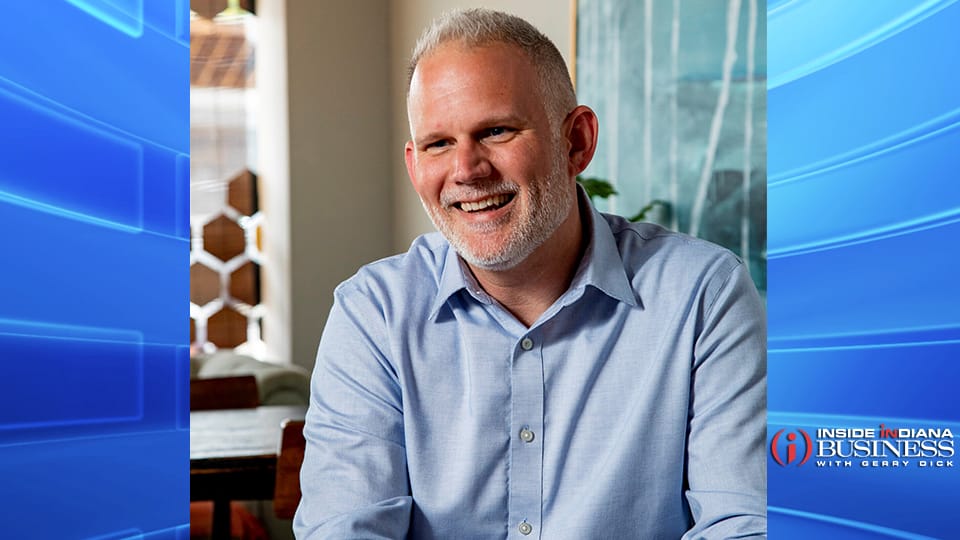
Earlier this year, Zac Heronemus became executive director of Tri-State Food Bank in Evansville. After a four-month search, the board of directors selected the Evansville 3rd Ward City Councilman to replace Glenn Roberts, who announced his retirement last year.
Heronemus spoke with Inside INdiana Business about the leadership experience he brings to Tri-State Food Bank and the “challenging climate” of funding and support.
This interview has been edited for length and clarity.
Tell me about your background before you became Tri-State Food Bank’s executive director.
Primarily, my background has been in nonprofit and public service, working through local government. I spent four years working with the county treasurer’s office in Vanderburgh County as the chief deputy treasurer and then spent another four years as development officer for United Way. I was development director at Tri-State Food Bank as well as executive director at Aurora.
I have two degrees from [the University of Southern Indiana], political science and a master’s in public administration that was a dual emphasis on government and nonprofit administration. I guess I’m one of those few folks who are putting their degrees to good use. And I’m in my second term as a city council person for the city of Evansville.
Why did you want to lead the food bank?
It was a good opportunity for me to grow as a professional. I have a passion for helping folks, and I enjoyed and was supported by my board at Aurora and the work that we did there. It’s taking another step, leading an agency that has many more partners, many more folks who are boots on the ground doing important work. Moving from one vital need in housing to another vital need: food.
We have an opportunity at the food bank to also reimagine what it is that we’re doing and think about what we can do, rather than just meeting a need and addressing hunger. How do we try to get upstream and work with our partners to provide greater opportunities and think about what food banks throughout the country are doing that we could be doing here as well? That opportunity to come over and reimagine and work with our team on more systemic work.
How will you use your past experiences to lead the food bank?
As a nonprofit professional, having my first job working in development with United Way has opened many doors as far as partnerships and support that nonprofits need. My experience as the executive director at Aurora, working in an environment where you have a blend of public and private support and government grants, set me up well to come to the food bank and operate in that same manner and environment of ensuring the viability of this organization.
It’s all about working with vulnerable people and having strategic and vital partnerships that can convene resources that help change people’s lives. Working with great people who have a great mindset as far as vulnerable people. I’m in a good position to take what I’ve done in the past and move this organization forward.
What are your short-term goals in this role?
The biggest thing right now is that it’s a challenging climate. Funding is up in the air. While this organization doesn’t rely wholly and heavily on federal dollars, federal programs are one of the biggest things that we do administer. When it comes to USDA commodity programs, we’re fortunate to have a good support base with corporate partners, individual donors and foundations that help us carry forward our mission.
But the reality of it is, whether it’s Tri-State Food Bank or any other nonprofit, continuing and garnering increased support to help us elevate our mission is a challenge. Focusing on that aspect, the financial sustainability goals that we have, but thinking about elevated culture at the organization. It’s a great opportunity for us to build a stronger team. A stronger team and a greater culture lend themselves to greater impact.
How do we look forward? How do we look to our peers who are doing innovative programming? There are a lot of food banks that are entering into workforce development environments, whether that’s directly or indirectly. But, most importantly, as a short-term goal, making sure that Tri-State Food Bank is sitting at all the tables that are working collectively to solve difficult problems in our community, both here and throughout the 33 counties we serve.
How are federal budget cuts affecting the food bank?
It’s difficult to tell right now. We’ve seen some Biden-era programs be phased out prematurely. Some of the biggest ones being the [Local Food Purchase Assistance] program, the local farmer produce program. What that was doing through COVID dollars was injecting and reinvigorating small family farms and giving a huge infusion into areas that are food deserts.
Southern Illinois, the 16 counties that we serve, is probably our most successful area where this program was carried out. Where we saw fresh produce, leafy greens, fresh meats, eggs, dairy, things that the USDA commodity programs don’t allow in abundance. It’s unfortunate to see high-nutrition programs that were doing such great work phased out so quickly.
The entire food banking system is operating out of an old farm bill that has essentially been flatlined since 2017. And what does that mean? That means that funding, whether it’s for Tri-State Food Bank or Gleaners Food Bank in Indianapolis or any food bank throughout the nation, is at the whim of the administration and Congress on whether they want to continue funding at that 2017 level.
The biggest thing that we see with immediate effects is the [One Big Beautiful Bill Act]. The $200 billion in [Supplemental Nutrition Assistance Program] benefit cuts are going to put a strain on food banks and the systems that they support.
Keep in mind, we have 250 partners in the 33 counties that we serve that are carrying out approximately 350 programs day in and day out. Many of my colleagues and peers throughout the nation and I are concerned about our partners and the strain on the system, where folks who are losing these benefits are going to need to access food pantries and other food programs that we are helping to carry out alongside our partners.
Time will tell on that. I understand the majority of cuts are in a delayed deployment. Meaning that they’re not going to hit full effect for a couple of years, but we’ll start seeing things incrementally ramp up, and, hopefully, it’s not that situation where we’re in the pot of water, and we don’t realize how hot it’s getting while we’re in it.
How can people help the food bank’s efforts?
We need financial support. We need volunteers. Volunteers are integral to helping us keep our costs low. Everything that we can do from a volunteer standpoint will help out tremendously to make sure that we’re being mindful of our operational costs while everything is flatlined.
But we also need champions and advocates. We need people to shout from the top of the mountains that we have vulnerable people who rely on these programs. And if we lived in a perfect world, we wouldn’t have them. But that’s not where we’re at right now.
We need to make sure that more individuals and families don’t continue to fall further behind. Whether it’s food or housing or other social services that help prop them up and help them improve their lives or help them have those opportunities to improve and move toward upward mobility, we need advocates and champions for all of us.