
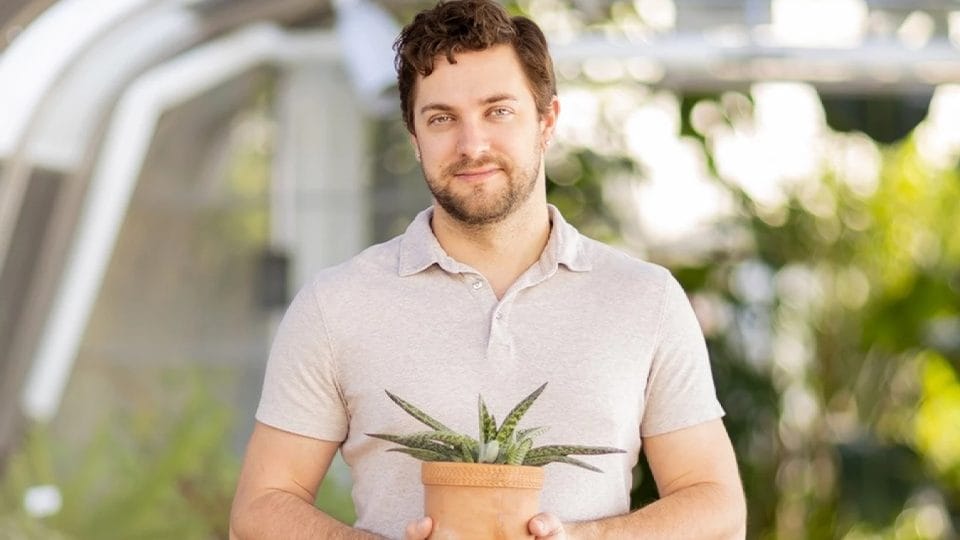
When Ben Futa moved back to South Bend in 2020 after several years away, he quickly realized he would need to create the job he wanted. With a background in horticulture and public gardens, Futa co-founded The Botany Shop, a plant-forward retail space that has since become a growing ecosystem of community, creativity and green infrastructure in the Near Northwest Neighborhood.
What started as a pop-up focused on indoor plants has evolved into something much deeper. A public garden in the making, a gathering space and a business model rooted in relationships and regeneration.
Inside INdiana Business spoke with Futa about the journey behind The Botany Shop’s growth, the values guiding its future and why matching a plant to a person is more art than retail.
This article has been edited for brevity and clarity.
Let’s start with your roots. What brought you back to South Bend in 2020?
I was actually born and raised here, but we were gone from 2015 to 2020. We moved back in 2020 mostly because of the pandemic. We were feeling disillusioned with institutions and just wanted to do our own thing at that point. I was the director of a campus demonstration and display garden up at the University of Wisconsin Madison.
So what inspired you to start The Botany Shop?
When we moved back, we were looking around for our plant place. Madison had several plant shops that we’d usually check out on the weekends. South Bend just didn’t really have that when we moved back. So as we were thinking about what we wanted to do and how we wanted to do it, we realized that the job we wanted didn’t exist. So we actually had to build the place that created the job that we wanted to have.
Was there a specific gap in the South Bend market that you were hoping to fill?
Back in 2021, indoor plants were the thing. They were paying our bills. The pandemic really drove home the idea of people filling their lives with green things, especially indoor plants. People were seeing plants in new ways. So we didn’t set out explicitly as a house plant store but it very quickly moved in that direction. We started as a pop up, and that allowed us to test out different sides of the market. And the energy was definitely in indoor plants.
All that said, the indoor plant bubble burst mid-2022. People were not paying what they were paying for indoor plants before. They’re still a big piece of our product line but not nearly what they used to be. So South Bend had garden centers but we didn’t have a plant shop.
How has your vision for The Botany Shop evolved since it began?
Things always take longer than what, in my brain, would have thought. I initially thought we’ll have this done in three years. But if anything, it’s gotten bigger in terms of the vision. Initially, it was just if we had an indoor space and an outdoor space, that would be great. That would be enough to keep me happy and satisfied for years. Then we landed in this neighborhood in particular, seeing all the vacant spaces around us and recognizing the potential in those spaces, we felt we needed to bring them together. We’ve nicknamed this the botany block. So we’re thinking about different ways that we can create a public garden … that looks different in every space. One is a flower field. One is a community garden. One is an outdoor plant nursery. We joke that we’re really building a public garden for South Bend, we just happened to build the gift shop first.
What key decisions shaped your growth in those early years?
Space was a big conversation for us over the first three years. We started as a pop-up; then we moved here. But because this space came together one room at a time, we were not entirely sure if this was where we were meant to be. Because in my brain, I always knew that the outdoor space had to include those demonstration plants. Demonstration gardens are what sell plants. But it takes three to five years to grow them. So if we were going to put down literal roots, we needed to make sure this was the right space and the right neighborhood.
We eventually made the decision to stay put in May of last year. Growing space was one of the big factors. When I first moved to the neighborhood, I made a point to connect with my neighbors. One day I noticed that the neighborhood farmer had let the land bare for a while. So I reached out to ask what the plan was. After a 30-minute conversation, she literally said we could have the space to grow flowers. That was the moment when we knew we would be staying put. That was the catalyst to update the business plan for a fourth time. We were finally going to raise the money to buy the building and expand.
So space was a big part of our journey because we can’t just pick up and move to a new space every three years. That’s not the nature of what this is. We are putting down roots quite literally. This is a generational project.
You’ve been called a plant matchmaker. What does that mean to you?
A lot of times, folks will come in and say, “I kill everything I touch” or “I’m just not good with plants.” My response is usually, “Well tell me what you killed and how it died.” Like a plant post mortem. Typically, it comes down to wrong plant, wrong place and sometimes, wrong owner. Some people really love to dote on their plants, they love to give them a lot of love. But it’s important to note, water does not equal love.
If you’re a hover parent, you like to check in with your plants every couple of days, you’re gonna be a great fit for an alocasia or a calathea that really loves to be babied. On the other hand, someone who only remembers to water every three months would be a great fit with a succulent, sansevieria or maybe a pothos. Those plants actually tell you when they need a drink because they’ll wilt. As soon as you water it, it’ll come back up. So it’s really about matching the right plants to your lifestyle, time and space. When you successfully grow a plant, it undeniably changes your soul.
How have your business offerings changed over time?
For the first three years, we did landscape installations. At the time because of revenue, it felt like it was checking the box for us. Part of our mission is to help people move away from conventional lawns. We tried to develop as many processes and systems to make it profitable but it was still wildly expensive and only accessible to only a sliver of the population. We did between 12 and 20 projects a year and that was not a fast enough pace of change for what needs to actually happen in the world.
Towards the end of last year, we did an enterprise analysis and the amount of money landscaping brought in did not justify the amount of energy we put in. The other piece that changed as we were committing to this space was the idea that we are building a destination. We are trying to give you as many reasons to come here and spend time here. Whether that’s getting a beverage and walking around. We have free Wi-Fi and outdoor seating. We’re collaborating with our neighbors to build a place where you want to come spend half a day, hit every store and spend your money locally. We’re doing a bouquet subscription and pickups coincide with the busiest part of our farmer’s market on Saturday mornings. So we’re trying to layer our programming so it all makes sense.
What role do community relationships play in your work?
I think it’s everything. Relationships to customers, relationships to other businesses, relationship to community as a whole. Especially being a plant-based business, we see this play out in the plant world. Ecology is about relationships. How one plant thrives in one situation is a direct result of how it plays with the plants around it. Conventional American horticulture has taught many of us to put a plant in and put a sea of mulch in between. That’s basically social distancing for plants. We all do better when we’re planted in community. Diversity maximizes resiliency and durability.
For example, being the only business in this strip was a weakness. So when Brain Lair moved in as a pop-up, I walked in and asked Kathy, the owner, what I could do to get her to stay here permanently? Because we need other retail. We need other local and independent shops. We need reasons for people to walk the half a block between our spaces. It’s fine for us to be a destination but we need more critical mass for this to be a sustainable neighborhood.
How have you seen plant awareness grow locally through your work?
We want to set everyone up to be successful. Something like plugs, there is no place where they are available in retail in this country; they can only be bought wholesale. The average home gardener/consumer cannot walk into a garden center and do what we’re doing here; it just doesn’t exist. Lawns are an ecological dead zone. They do absolutely nothing for us. So our whole shtick is, “How do we accelerate the pace of change?” You could grow food, you could grow an orchard, you could grow a flower. You could do so many other things than lawn, and that’s part of what we’re trying to demonstrate.
As one example, we hosted two lawn conversion workshops this spring. Those people have been my best and most returning customers this spring because they have the knowledge to go with it. So far, we’ve sold more than 2,500 plugs. I didn’t know what to expect because it’s the first year but people seem to respond to them very well.
What can people expect from The Botany Shop in the near future?
We’ve really been in a growth mindset for the first few years, and now we just need to operate for a minute. When we’re ready to grow again, I know we’re gonna be really good at it because look at what we’ve done up to this point. But I’m so ready to just focus on systems, optimization and efficiency. Getting this to be a well-oiled machine that doesn’t drain us of life.
In the next couple years, food and beverage is going to be a thing. Hospitality is going to be a thing. We bought a house next door that could potentially turn into Botany B and B. I’m envisioning what goes into a destination: eat, shop, stay. We’ve got one of those down, the other two will be coming at some point. But that’s at least three to five years away at this point. I’m really looking forward to finding our groove and sticking to that groove for a few years. Also, we have community based investors that have entrusted us with their treasure. Now it’s on us to return that treasure.
Tell me about your upcoming event, Plant Pride. What can people expect?
Plant Pride is our birthday celebration—part block party, part maker-market. We have live music, food trucks, 20 local vendors, artisans, makers. Basically celebrating all the ways we grow together. Again, a lesson from the natural world, cross pollination is where the power is. All of these 20 makers, for instance, have their own following, their friends, their family, their super fans. The fact that we bring them all together and curate them in this space creates a chance for that cross-pollination to happen. So Plant Pride is basically a day of relationships. The number of people that I see hugging and crying should be a metric in and of itself to define the success of the event, just watching people connect.
The bottom line is, we cannot compete with the corporate giants on cost or convenience as a local and independent business. But we can compete on community in a way that big box and online retailers cannot. So I encourage all local and independent retailers to lean into community. Make community an essential output of what you do.