
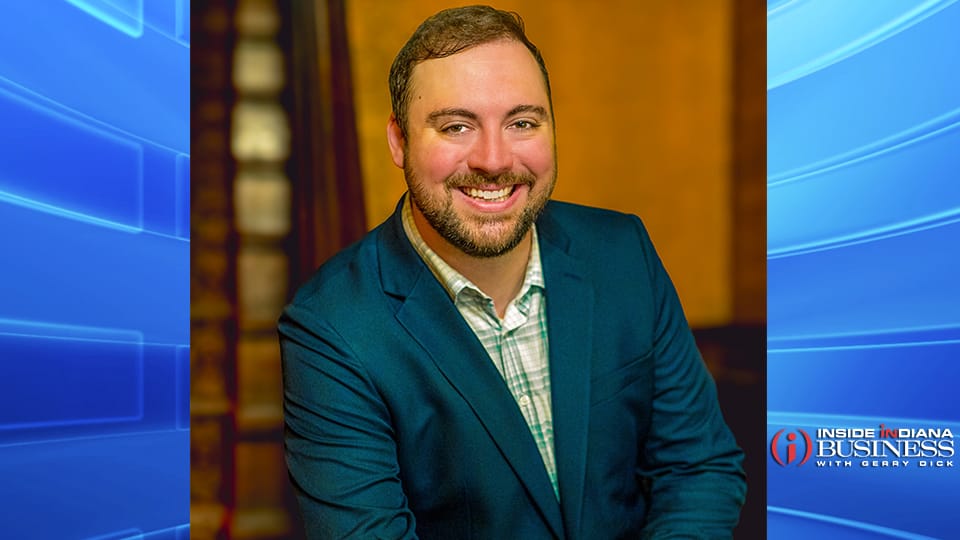
In June, Joseph Lutz became executive director of Evansville’s Reitz Home Museum. The Victorian house located in the city’s downtown Historic Preservation District is recognized as one of the nation’s best examples of French Second Empire architecture.
Lutz spoke with Inside INdiana Business about the museum’s legacy and his goals as executive director.
This interview has been edited for length and clarity.
Tell me about your background.
I graduated from Purdue University with a degree in business management, a concentration in international business and a minor in history. I had interned at the Reitz Home Museum in 2015, and I would help from time to time when I came home because I’m from the Evansville area.
I end up going into the Peace Corps. I served in Moldova as a community and organizational development volunteer. I lived in a small village for two years, working with a librarian and a lot of other small non-governmental organizations, helping them develop their skill sets and expanding the library to be more like a community center for the local village.
The pandemic brought us all home, but then another opportunity came up to go back into the Peace Corps. This time, Peace Corps Response. I ended up working back in Moldova as a concept development and museology advisor to the Jewish History Museum of Moldova. It’s a new museum. They’re at that foundational level.
While we were there, they got access to their building, which will take years to fix up so that they can have their own place. Creating a strategic plan, documentation to help them plan for the future and get ready with new exhibits and things like that. That ended in a little bit before June 2024. Then I accepted a position here at the Reitz Home Museum as the curator. Now I’ve been promoted to the executive director.
What were your successes as the museum’s curator?
We have done quite a bit that I’ve been proud of. Growing our docent program has been something. We hardly had any docents. They have a wealth of knowledge. Whenever guests come to the museum, docents are the ones who give the tours. Doubling the size of active docents was one of my achievements.
Another aspect is that we’re doing this big inventory assessment. Making sure every single item in our museum is accounted for, and then having a list to say, “Is there anything missing, or is there anything that was moved from room A to room B?” Making sure everything’s been cataloged properly. That’s also something I’m proud of.
There’s still a little work to do on that because that is a long process. But it’s something to have a majority of our items cataloged in one location. As a 50-year-old organization, we had them on note cards and in two or three different systems, like Excel, Microsoft Access and our cataloging system.
Why did you want to be executive director?
I see a lot of opportunities and a lot of things I feel like I can help move the organization forward. Working with the board, our members, the people who care a lot about the museum, donors and docents. I’m at that age where I appreciate the past and what has been done here.
I’m also open to new ideas and growing our organization and programming and things like that. One of the things I’m looking forward to is doing more collaborations with other museums and other nonprofits in our community.
What are your short-term goals?
Growing our membership donors, getting them more involved. Putting out a quarterly newsletter, sharing a little highlight about some of our collection items. Opening the home so people are at the museum and can see more of our items and that we’re more of a community asset, something that people think of when they think of Evansville in southern Indiana.
Looking ahead to 2026, doing more temporary exhibits, collaborating with organizations, showing off more of our collection items.
What about long-term goals?
How can we be more sustainable with the constant change of where grants are coming from and where places that used to give money or where we could have looked for grant funding no longer exist? Finding long-term ways for us to be sustainable financially, and all around, but financially is what I’m mainly speaking about, and ways of restoring the museum and keeping it to that high standard.
A lot of people call the Reitz Home Museum Evansville’s Victorian jewel. Living up to that expectation and making sure that we have funds set aside for restoration work and emergency restoration work. Because with any home, something might happen that’s unexpected. And growing our community connections. For a long time, we did our own thing, but now it’s time for us to be more engaged with other organizations and community partners.
Why is the museum important to you and the community?
The Reitz Home Museum tells about the Victorian era, specifically the Reitz family, which people call one of the founding families of Evansville. It shows this family made a lot of wealth through the lumber industry and getting involved with a lot of other businesses like banking, a telephone company, railroads, you name it. They accumulated a lot of wealth, but then they gave back to the community.
Evansville has two high schools because of the family: F.J. Reitz High School and Reitz Memorial High School. They helped bring the University of Evansville to town. They gave money for churches to be built, for Little Sisters of the Poor, a retirement community. They even gave to an orphanage in Vincennes to build and expand. It’s a story that a lot of people, even people who might never attain that kind of wealth, can see as a story of America and Evansville.
There’s something relatable for everyone when they come to the museum. Seeing the quality craftsmanship. The artwork. Each room, the floors themselves are art.
What’s next for the museum?
Our Wine Down to the Weekend series is a free event where we have local musicians come out and play on our veranda on our porch. In the fall, it’s really enjoyable with the weather. It’s a little bit of a fundraiser, because we get sponsors, and you have to buy drinks if you want any, but otherwise it’s free to enjoy local musicians.
Our big event is our Victorian Christmas. That starts the Friday before Thanksgiving and goes all the way until Jan. 3. It’s a big undertaking. We get designers from the local area to do all the different rooms. It’s a magical Christmasy time.
We’ll have some special events where we do candlelight tours. The house will be filled with electric or battery-powered candles throughout the home, and you will take a step back in time. Last year, we got a hot chocolate truck to stop by, so we’re hoping we can get them to come back.
We’re continuing to raise funds. We’re going to be working on our exterior restoration and fixing up some of the woodwork and some of the exterior parts of the home, including fresh paint. With any historic building, you’re constantly having to do some sort of restoration work.
We are still waiting to hear on a few grants, and I’ve had site visits with one. We have received a Heritage Support Grant to allow us to start work on the Ice Box room project. Heritage Support Grants are provided by the Indiana Historical Society and made possible by Lilly Endowment Inc.