
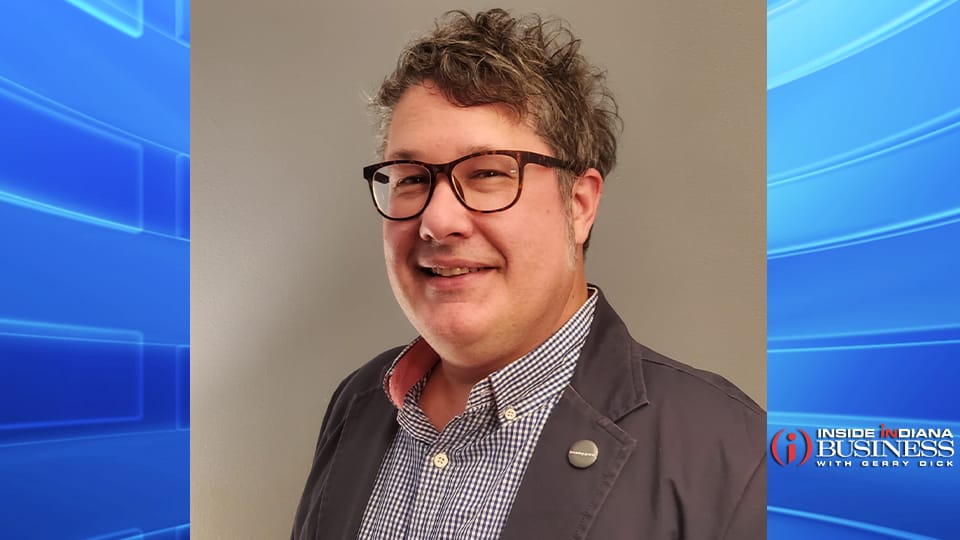
Adam Watkins is just a few months into his new role as assistant vice president and dean of the Vincennes University Jasper campus. The Illinois native was appointed to the position in July and started the job in August.
Watkins spoke with Inside INdiana Business about his experience with community colleges and VUJ’s role in the region.
This interview has been edited for length and clarity.
Tell me about your background before you came to VUJ.
I’m from DeKalb, Illinois. That’s a very rural community. It’s about 60 miles west of Chicago. I spent a lot of time in cornfields as a kid.
After graduating from high school, I worked for the streets department for a little while. I went to Kishwaukee Community College to start my educational career. That’s where my love of community colleges took hold.
After that, I transferred to Webster University in St. Louis and finished a bachelor’s degree in art and design. Then I moved to Canterbury, England, and studied at the Kent Institute of Art and Design for my master’s work.
When I came back to St. Louis, I worked as a graphic designer for a few years. And then I started teaching graphic design and basic art and design courses at a couple of private liberal arts universities and a community college.
In 2006, I took a job as a full-time art instructor at East Central College, a community college about 45 miles outside of St. Louis. During that time, I started to work my way up, taking on more responsibilities, learning more about administration and what folks needed. I ended up being the chair of the fine and performing arts department.
Then in 2020, in the midst of a pandemic, I thought, “This is a great time to change jobs.” I went to Lincoln Land Community College in Springfield, Illinois, as the dean of arts and communication. I spent five years there.
Part of that was working closely with program advisory groups and what we call the Workforce Institute, looking at how we could align academic programs to the workforce needs regionally, looking at how we could embed employability skills and strengthen those partnerships with our local businesses and make sure what we were doing connected to those community needs.
Why did you want to be VUJ’s assistant vice president and dean?
I was stimulated at Kishwaukee Community College about what the community college did and what it did for me. As I looked at what VUJ is about, this role brings together the things that I care about: access to education, community impact and meaningful leadership. How Vincennes University as a whole, from President [Chuck] Johnson to the connection down through VUJ, how it’s uniquely positioned to drive change.
I was excited to be a part of that passion for student access, looking to remove barriers. I believe in community-embedded education so that we’re making sure we’re responding to the needs of our community. Looking for an opportunity to lead, wanting to be transparent and collaborative as we look to grow. And then look at how we can be innovative.
What are your short-term goals in this role?
We want to make sure that we’re strengthening the student experience. And part of that means we’ve got to make sure we’re supporting our students in all sorts of different ways beyond just financial, beyond courses. We’re talking about mental health. We’ve got to support our staff and faculty. We want to build those relationships in the community, make them deeper, nurture them.
We want to make sure we’re enhancing those student support systems and removing barriers to access and completion. We want to foster a campus culture of trust, collaboration and transparency and build intentional partnerships with our local employers and schools.
What about long-term goals?
We want to be aspirational. We want VUJ to be a regional leader in accessible, high-impact education that meets the needs of southern Indiana. We want to grow enrollment. Looking at how we can be better partners for our adult learners. Folks who maybe college wasn’t an opportunity for them coming out of high school, but now they’re looking to upskill or retrain.
Looking at underrepresented groups. How do we make sure they have access to education? We’re going to have to be flexible in how we’re looking to offer courses. Those learning models, maybe not sitting in the classroom all of the time is the best model. Looking at hybrid opportunities where there’s more hands-on opportunity to experience the curriculum outside of the structure of the classroom.
But my role is also about strengthening the identity of VUJ. We are a hub for lifelong learning, and we want to be synonymous with economic mobility.
What challenges do you foresee in this role?
The landscape is changing rapidly, but we have to look for the silver linings. We have to look for the opportunities. VUJ can be at the forefront of innovation and equity in education.
We’ve got an opportunity that we need to embrace: how can we grow enrollment? We’ve got to engage those new learners. We’ve got to make sure we have the opportunity to align more closely with our workforce needs. We’ve got to make sure we’re embracing the ability to champion access and equity for our rural and underserved students. We’ve got to embrace the opportunity in front of us to elevate VUJ’s visibility, not just locally but regionally.
And then, an opportunity that’s always at any institution, we’ve got to empower our faculty and staff. And we do that with good, clear, constant, cohesive communication support. We look for those opportunities of shared leadership. We want them to have agency and engagement in all the work that we do.
What is the state of higher education in the Midwest?
The Midwest takes on things differently than the coasts do. And that’s not a negative thing at all. If we think about what is truly American right now, it’s the Midwest work ethic and the ideology of home and community. And that’s not to say that the coasts don’t feel the same. But this is a real opportunity. We’ve got to redefine what success looks like for students in Indiana with high schools and the new tracks for diplomas. We have to be responsive to that.
The other big overarching trends, reaching out to non-traditional students, the employer pathways and partnerships, those are things that have to be on the mind of institutions of higher ed in the Midwest. There’s also got to be reinvestment in our faculty and staff well-being, which is in response to what we’re seeing culturally around us. We have to make sure the culture inside our walls is positive and conducive to teaching and learning.
But we’ve also got to be nimble and smart in looking at how we can leverage somewhat limited resources and looking for external opportunities to seek other resources, whether that’s through different collaborations or innovation. How do we continue to invest in the work we do to grow our region?
There’s a giant push for community and workforce development. That’s been made clear across the Midwest. As we sit here in southwestern Indiana, it’s a bit of a manufacturing hub. We’ve got to make sure we are connected to that, and we maintain our connections.
What role does VUJ play in the community?
Internally and externally, we provide opportunity, we support growth, and we want to help build a strong and skilled local workforce. That means, as we’re investing in the educational programs we have, we are creating a community that is more educated, more understanding, one that is more willing to give back. And that also reflects on the people who come to work with us. So we’ve got to maintain our ability to be affordable.
We’re working with high schools to make sure that we’re increasing our dual credit and enrollment opportunities for those high school students to get some credits under their belt. Some of them graduating with associate’s degrees. Many of them graduating high school with certificates.
The other thing is we want to be a part of economic and community development, and part of that is us being open, inclusive and pushing that idea of lifelong learning.
What else is new at VUJ this year?
There are quite a few folks who have stepped into new leadership roles, which is exciting. There’s a real sense of positivity and momentum on the campus right now. Our enrollment is getting close to where we were pre-COVID. We had over 200 first-year, full-time students enroll this semester. We’ve got about 220-some odd high school students doing programs on our campus through the Patoka Valley Cooperative.
We do the CTIM [Center for Technology, Innovation and Manufacturing] Challenge in November. Students in STEM-related areas compete in different business and industry competitions on campus. It’s a nice mix of seeing high school students working through projects and some of our students who are in programs with the local businesses and industry.
Anything else you’d like to add?
At VUJ, we’re just getting started. I’ve been inspired every day by our students, faculty, staff and partners who help to make this work meaningful. We have an opportunity to help shape the future of our region through education and innovation. With that shared purpose, a lot of exciting things can happen.