
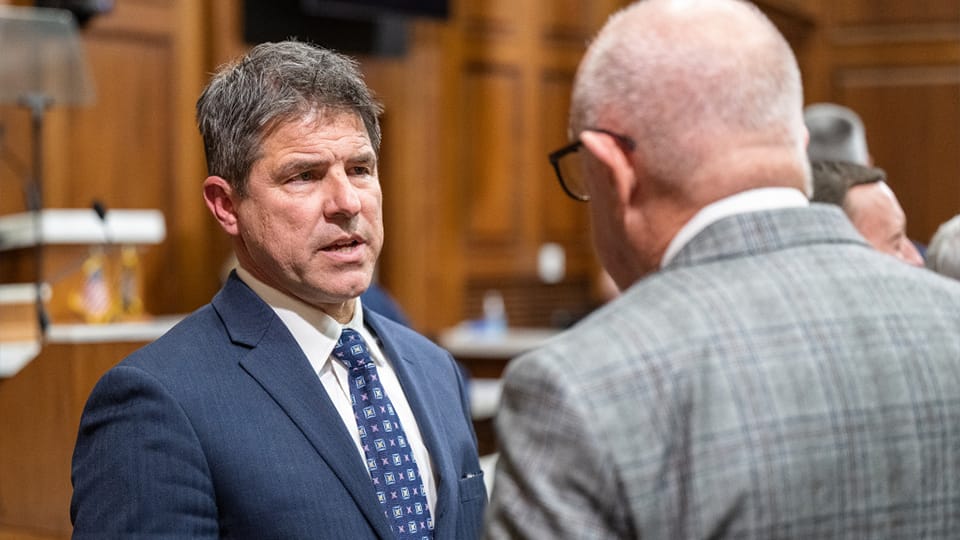
After months of speculation and pressure from the Trump administration, Indiana Senate President Pro Tem Rodric Bray announced Friday that his chamber will not meet in December to consider redistricting.
“Over the last several months, Senate Republicans have given very serious and thoughtful consideration to the concept of redrawing our state’s congressional maps,” Bray, a Republican from Martinsville, said in a written statement. “Today, I’m announcing there are not enough votes to move that idea forward, and the Senate will not reconvene in December.”
Both the House and Senate were expected to start the 2026 legislative session early on Dec. 1 to take up the issue after Gov. Mike Braun issued the call for a special session on Oct. 27. Mid-decade redistricting has been a recent focus of President Donald Trump’s administration, which hopes the effort would bolster Republicans’ chances of maintaining control of the U.S. House of Representatives in the 2026 midterm elections.
Indiana’s Congressional delegation is currently a 7-2 Republican majority. Those who supported redrawing new maps had hoped to turn that into a 9-0 Republican advantage.
In a statement Friday, Braun chastised those legislators who no longer plan to convene.
“I called for our legislators to convene to ensure Hoosiers’ voices in Washington, D.C., are not diluted by the Democrats’ gerrymandering. Our state senators need to do the right thing and show up to vote for fair maps,” Braun said in a written statement. “Hoosiers deserve to know where their elected officials stand on important issues.”
Instead of meeting in December as previously planned, Bray’s office says the Senate will convene for Organization Day, or Org Day, on Tuesday, typically regarded as the ceremonial start of the legislative session. After that, Bray said the Senate will recess and meet again Jan. 5.
It’s unclear whether the House will still convene. A message to House Speaker Todd Huston’s office was not immediately returned Friday.
The announcement comes after weeks of signaling from Bray that there weren’t enough Senate votes to redraw the maps, and despite a monthslong pressure campaign from the White House that saw Vice President JD Vance visit Indiana twice and Trump join a call with Hoosier Senators in October.
Trump’s allies, including Braun, have said redistricting is necessary to combat gerrymandering by Democrats in other states. Democrats have pointed out that around 40% of Hoosiers voted for Democrats in the 2024 presidential election, yet Republicans hold close to 80% of Indiana’s Congressional seats.
During the December session, Braun had also asked legislators to tweak Indiana’s tax code to bring it in compliance with new federal changes. It’s unclear when that topic would be taken up.
Following Bray’s announcement, Senate Democratic Leader Shelli Yoder, of Bloomington, credited Hoosiers with standing up to President Trump.
“Washington insiders pressured the Governor to rig Indiana’s congressional maps in the middle of a decade for one reason. They were afraid of voters. They were afraid of losing power the honest way,” Yoder said in a written statement. “This should have never been considered. Not for one day. Not for one dollar. Not while families across our state are struggling to afford groceries, child care, health care and energy bills.”
Texas was the first state to approve new congressional maps at Trump’s urging, doing so in August. Since then, Republican majorities in Missouri and North Carolina have also redrawn maps, while California countered with maps of its own to favor Democrats.
So far, Kansas and now Indiana are the only states where Republicans considered redistricting, but—for the time being—have not moved forward.