
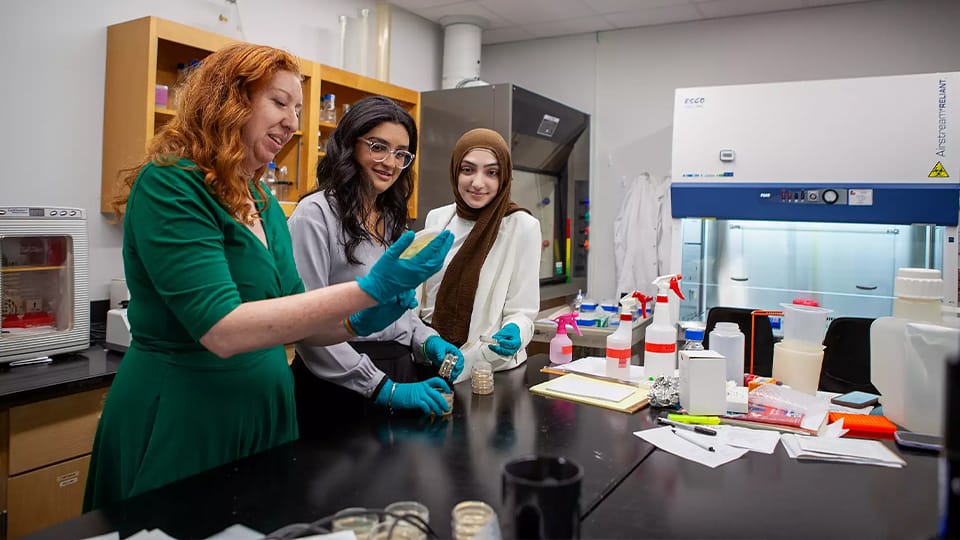
An associate professor of biology at Indiana University Northwest recently was named a 2025 E. Kika De La Garza Science Fellow, a USDA initiative that aims to strengthen relationships with Hispanic communities.
Jenny Fisher was among eight science fellows selected by the U.S. Department of Agriculture.
Established in 1998, the fellowship is given to faculty or staff at Hispanic-serving higher education institutions or Hispanic-serving school districts so that they can learn how the USDA can benefit them, their students and their communities, the USDA said in a news release. The fellows spend one week in Washington, D.C., learning about research, policy and issues and one week collaborating with other scientists.
“It seemed like a really interesting thing to do, to learn more about what the USDA does, so I could bring that into my classroom,” Fisher said in an IU news release. “Before this experience, I only knew the tip of the iceberg.”
Fisher researches the impacts of fecal pollution from septic systems and combined sewer overflows on human health. Much of the sewer infrastructure in Gary is old, and when the system gets overwhelmed, untreated sewer water can flow into the Little Calumet River and possibly Lake Michigan.
“That creates some potential health risks when you have people using beaches nearby,” she said.
Following her week in D.C. as part of the fellowship, she spent a week collaborating with other scientists at Ohio State University on soil drainage.
“The OSU scientists have some really cool, high-tech ways of collecting and measuring data about the water,” Fisher said. “I was really interested in learning about what types of analysis they do.”
Meanwhile, her microbiology background helped fill a gap among the scientists there.
“It seems there are a lot of opportunities in the future to collaborate and work on projects,” she said. “That was very exciting.”
Fisher said the experience has her thinking about ways she could involve soil and water conservation districts and local farmers in research opportunities.
“I’m thinking about how we engage those people in our research and how the USDA’s best practices might make a difference for water quality in our area,” she said.
Since the E. Kika De La Garza Fellows Program was established in 1998, the USDA has hosted nearly 450 faculty and staff in an effort to strengthen relationships with Hispanic-serving institutions, the USDA news release said.