
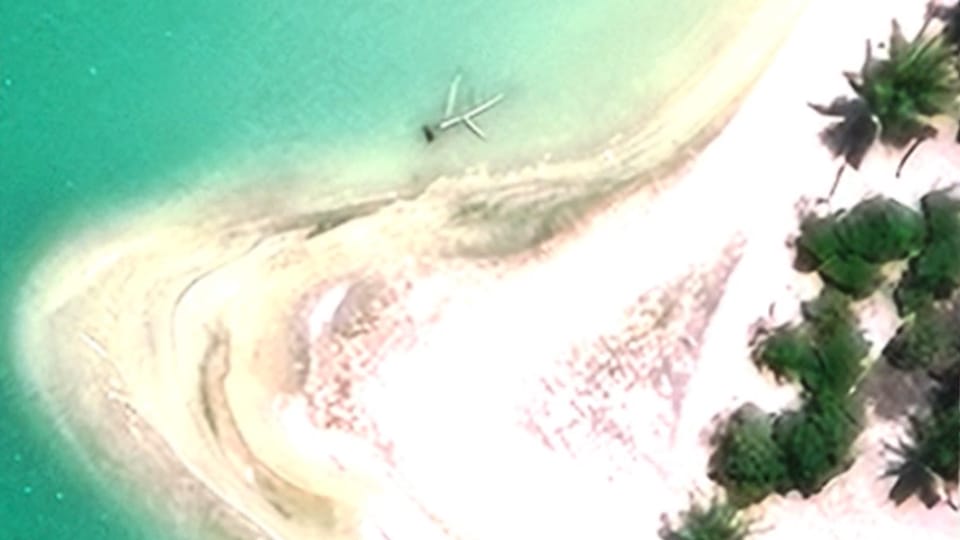
In fewer than 30 days, a group from Purdue University and the Purdue Research Foundation will embark on an Archaeological Legacy Institute expedition to attempt to find Amelia Earhart’s long lost plane in the South Pacific.
The expedition, plans for which were first announced in July, will take the group to Nikumaroro Island, where a visual anomaly known as the Taraia Object was first identified in satellite imagery in 2020.
But if the Taraia Object is positively identified as the Lockheed Electra 10E flown by Earhart and her navigator, Fred Noonan, before mysteriously disappearing 88 years ago, who gets control of it?
During a virtual news conference kicking off the countdown to the expedition, Steve Schultz, senior vice president and general counsel for Purdue, said the legal rights of the plane would go to the Republic of Kirabati, which owns the island territory.
“As a matter of international law, maritime law, things that are discovered within the territorial waters of a sovereign country are normally under the dominion of the sovereign nation,” Schultz said. “We would seek to establish a long-term relationship with Kirabati, and in return, we would be honored to return the remains of the Electra to Purdue, which is what Amelia wanted.”
Schultz referenced communications that Earhart and her husband had with then-President Franklin D. Roosevelt and Purdue President Edward Elliott, respectively, in which they indicated that they wanted to return the plane to Purdue for a permanent exhibit.
“We would seek to support Kirabati as part of that effort,” Schultz said. “We would make an investment, and we would include…the artifacts of the Earhart archives that we already have with this. That’s been our approach.”
The Purdue Research Foundation and others funded the “flying laboratory” that Earhart later used in her attempt to circle the globe and set a record for the longest-distance flight. The aircraft disappeared on July 2, 1937.
“Purdue does not have a legal claim on the plane, because the Purdue Research Foundation gave the money to her in the form of an outright grant that she then used to acquire the Electra from Lockheed,” Schultz said. “Nonetheless, my line is that we have an equitable claim to the remains of the Electra because her intent to bring it back to Purdue as expressed at the time.”
Purdue says a host of circumstantial evidence supports the Nikumaroro hypothesis, which suggests that Earhart and Noonan did not crash at sea but instead landed and were marooned on the uninhabited island, which is about halfway between Australia and Hawaii.
That evidence includes radio bearings at the time, bones discovered on the island, artifacts such as a woman’s shoe and compact case dating to the 1930s, and the Taraia Object, which was located in 2020.
Expedition Timeline
Schultz will join Sirisha Bandla and Marc Hagle, both Purdue alumni and members of Purdue’s Cradle of Astronauts, on the 15-person crew. The expedition will convene on Majuro in the Marshall Islands and depart on Nov. 4, sailing about 1,200 nautical miles to Nikumaroro.
The crew will first inspect the Taraia Object through video and still images, followed by remote sensing with magnetometers and sonar. Then, an underwater excavation will begin to expose the object for identification. The effort will also include a walk-over survey of nearby land surfaces to search for washed-up debris.
The expedition is expected to return to Majuro around Nov. 21 and fly home the following day, Purdue said.
“Finding Amelia Earhart’s Electra aircraft would be the discovery of a lifetime,” said Richard Pettigrew, executive director of the Archaeological Legacy Institute. “Other evidence already collected by The International Group for Historic Aircraft Recovery establishes an extremely persuasive, multifaceted case that the final destination for Earhart and her navigator, Fred Noonan, was on Nikumaroro. Confirming the plane wreckage there would be the smoking-gun proof.”
While the trip is about a month away, the expedition team is continuing preparations. The team traveled to the Museum of Flight in Seattle, Washington, to photograph a Lockheed Electra 10E that is identical to Earhart’s plane.
During the virtual news conference, Pettigrew said if they are able to confirm that the Taraia Object is indeed the aircraft, then the team will come back the following year to do a full-scale excavation.
“This is an archeological project, so we’re taking it in the same set of steps as an archeologist would do on any project,” he said. “You first investigate what it is you’ve got, what you need to do, and then you design a plan to go and do it. So we’re going to design a plan to go and do a full-scale excavation to learn everything we can about the site itself, and with the idea, not only of gathering that information, but also the potential of examining the potential for recovery of the wreck and bringing it home.”
Eric Dick contributed to this story.