
As WNIN Tri-State Public Media prepares its next budget, the Evansville organization must find a way to solve a $1.5 million shortfall due to state and federal funding rescissions.
President and CEO Tim Black said the loss of government funding has significantly impacted WNIN’s planning for Fiscal Year 2026, which starts on Oct. 1.
“For me, in percentages, it’s a 47% cut out of my budget. So I’m basically losing half of my budget, just like that,” he said.
In April, the state rescinded $7.35 million in funding over the next two fiscal years for Indiana Public Broadcasting Stations, a nonprofit that contributes to 17 radio and television stations. A few months later, Congress removed $1.1 billion in funding over the next two fiscal years for the Corporation for Public Broadcasting, a nonprofit that supports NPR, PBS and their member stations.
Black said WNIN, which operates both a radio station and a television station, will be able to survive in the short term, but the long-term need will be great if state and federal support is not restored.
“We have a healthy reserve account that will take care of us for one year. And with some of the budget cuts that we’re making right now and planning for the next fiscal year, we will probably be fine for at least two years. At that point, we’ll have to see some kind of government funding come back into the picture. It’s going to be tough after a couple of years down the road,” he said.
IPBS, CPB funding loss
The removal of IPBS funding resulted in WNIN losing about $446,000 in each of the next two fiscal years and the elimination of the statewide reporting team at the end of 2025. Black, who’s on the IPBS board of directors, said terminating the Indiana Public Broadcasting News reporters and editors was unfortunately necessary.
“My background in this business started in journalism, and I appreciate its importance, and I certainly appreciate its local importance, and I throw statewide coverage into that same basket,” said Black. “There is a severe erosion of good local journalism occurring right now, and I hate the fact that our organization has to be part of it.”
The rest of WNIN’s budget shortfall stems from the federal funding cuts at CPB, which will begin winding down operations at the end of this month.
“I truly didn’t think that would ultimately happen. I expected the Senate to save [the federal funding]. And then beyond that, I felt like there was going to be some way that something was going to work itself out,” Black said.
Black also expected a grace period to allow organizations to prepare for the federal funding loss, but the effects were immediate.
“I didn’t think that they were going to yank the rug out from under us, because most every station around the country would see their first tranche of dollars coming up in either October or November,” he said. “So the fact that it happened so quickly was probably the biggest surprise to me.”
Bracing for impact
To make up for the funding gap, Black believes WNIN will eventually have to reduce staff, a move PBS recently made by cutting 15% of its jobs. However, the first focus at WNIN will be programming cuts, specifically national shows.
“We have made a firm commitment to our local programming. Any of the local programming that we do on both the radio station, the television station, and all of that stuff finds its way to our digital platforms, all of that we’re keeping,” said Black.
One of the WNIN president’s greatest concerns about the federal funding setback is a grant the organization was awarded in November to pay for a new transmitter that’s desperately needed.
“It’s a grant program that comes through FEMA, but it is administered by CPB,” Black said. “We still haven’t purchased the new transmitter because we can’t get firm approval from anybody that the dollars are even still available to us.”
If state and federal funding doesn’t return in the future, Black is already thinking of ways to keep WNIN in operation.
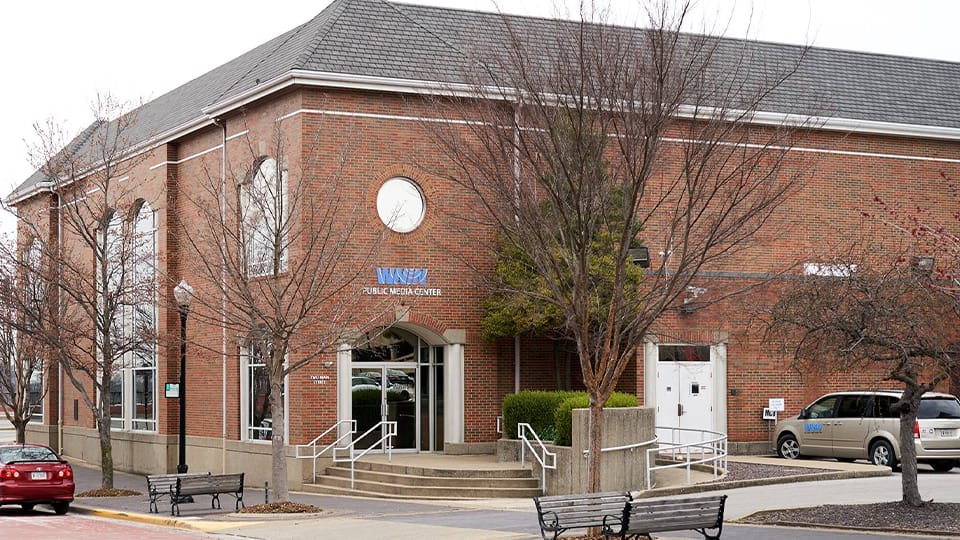
“We own our building, and it is in a very desirable location in downtown Evansville,” he said. “I don’t want to have to sell the building, but that would be the next step if we were faced with not seeing any money at all from government sources. That would provide us with a nice amount of revenue that ideally would also get put into an invested reserve account.”
‘An essential news source’
In a show of support for public media, several Evansville leaders signed a letter circulated by the Alliance for Rural Public Media in July asking Congress to oppose the funding cuts. The list included Indiana State Sen. Vaneta Becker and Vanderburgh County Sheriff Noah Robinson.
“I view public radio as an essential news source for getting out information from the government to the community, particularly in rural areas, that is unvarnished, unfiltered, with no spin,” said Robinson. “You could argue that now with social media and the internet that its importance is diminished. I would argue just the opposite, that with all the garbage that is on the internet these days, its importance has never been more critical than it is right now.”
Becker, who represents portions of Vanderburgh and Warrick counties, said she’s also worried WNIN’s funding loss will limit access to public information.
“We need for people to be informed, and this may reduce the ability of the electorate to hear what’s going on at the statehouse. And not only the statehouse, they have programs on local issues with local government officials as well,” said Becker.
Black said NPR and PBS are supporting their member stations by waiving portions of programming fees over the next fiscal year. Local patrons have also stepped up with $5,000 and $10,000 donations.
“I’m absolutely so appreciative. It almost makes me cry sometimes with the amount of support we’re receiving from the community. But it takes a lot of $10,000 checks to cover a million and a half dollars,” Black said.
Sustaining support
While Black is thankful for the contributions, he’s also apprehensive that support for WNIN will fade over time, especially if people don’t notice any changes in the interim.
“We may continue along looking relatively normal to a lot of people and a lot of corporations because we’re getting a lot of help right now, but that help is not going to last,” he said. “This loss of funding from the government, whether it’s the federal dollars or the state dollars, it’s going to be just as critical six months or a year from now as it is right now.”
Robinson suggests that supporters commit to a monthly contribution vs. a yearly donation to help the organization strengthen its mission of public service.
“We’re all too willing to shell out $10, $12, $15 for a streaming service that we probably hardly ever watch,” he said. “I would encourage everyone who values high-quality local and national reporting to write a check [to WNIN] and consider being a sustaining member where you don’t have to worry about it.”
To donate to WNIN or check out the benefits of becoming a sustaining member, visit the website.
“I hope that [WNIN] continues to fundraise, and I hope the public supports them as much as possible,” added Becker.