
Evansville Endowment Fund grant cycle starts in May; over $500K awarded in 2024
Subscriber Benefit
As a subscriber you can listen to articles at work, in the car, or while you work out. Subscribe Now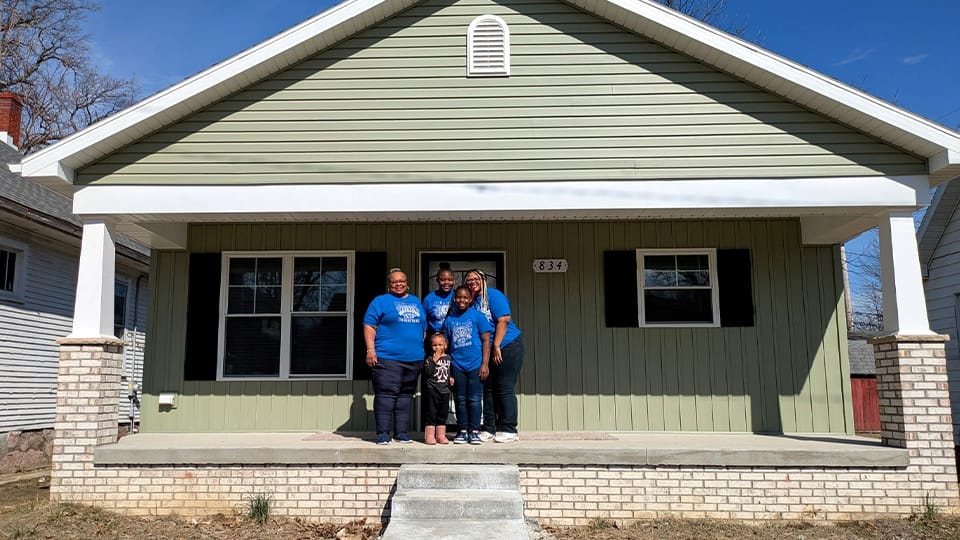
The Evansville Endowment Fund’s next grant cycle to fund capital improvement projects within the city begins in May. In November, the grants committee bestowed more than $505,000 to 23 nonprofits, including Habitat for Humanity and Impact Evansville.
As the supporting organization of the Community Foundation Alliance, EEF annually awards grants to nonprofits through an application and review process. At least 60% of the entity’s annual funds must be allocated to organizations serving Evansville’s 4th and 6th Wards.
Melinda Waldroup, CFA’s chief program officer, manages the EEF grant cycle. She said past projects have ranged from new roofs, windows and HVAC systems to fencing, parking lot resurfacing and security systems.
“An important project for Southwestern Health Care was to have some drop off parking adjacent to their building so when people come with some mental health crisis situations, it’s an easier way to have these patients or clients come in and receive care,” said Waldroup. “One of the most unique ones we did was granted money to install a hydration station at Riverfront Park in Evansville.”
About Evansville Endowment Fund
More than 30 years ago, EEF was born out of a proposal by Frank McDonald II, the mayor of Evansville from 1987 to 2000.
“[EEF] is made up of money that came through the city of Evansville when the casino was first brought to Evansville. The $5 million of revenue that the city first received from the [Aztar] gaming boat that came to us to endow,” Waldroup said.
The distinct legal entity managed by CFA was created as a public charity under the alliance.
“[EEF is] connected to [CFA] because they do the same work that we do, which is grant monies to nonprofits to support our communities. So that organization can receive public charity [tax] status based on their relationship with us,” said Waldroup.
CFA has a network of nine community foundations or affiliates in southwest Indiana.
“Each county has an advisory board that focuses on needs in the community, recommends grants to be made to nonprofit organizations in their communities and recommends scholarships to be awarded to students in their communities,” Waldroup said.
EEF has a board of directors that makes governance and grantmaking decisions. Waldroup said the entity has awarded more than $6.8 million through over 400 grants since its inception.
“A lot of funders don’t do larger capital projects. And so it can be harder for nonprofits to get the renovation work, repair work or construction work done. That’s a funding opportunity for them that we can provide through the Evansville Endowment Fund,” she said.
Habitat for Humanity
Habitat for Humanity of Evansville received $23,000 in the last EEF grant cycle to help build homes in Tepe Park and Jacobsville between November 2024 and November 2025. Major Gifts Officer Sr. Jane Michele McClure said the goal is to improve these disinvested communities by adding new homeowners.
“No other private developer is going to go in there. They don’t see the opportunity for a profit. But if Habitat goes in, and we start investing, and we start building new homes, people living around there start sprucing up their houses. It just happens,” she said.
So far, seven homes have been dedicated and two houses are nearing completion in Tepe Park. Ten houses remain under construction in Jacobsville.
“Our little secret sauce is that zero-interest mortgage. That’s what makes homeownership affordable if you’re low-income. Of course, they have to put in 300 hours of sweat equity. We like to tell homeowners that every hour you contribute, you’re giving yourself back a lot of money because you don’t have to pay interest on that loan,” said McClure.
Habitat and EEF have a long history together. The nonprofit has been awarded grants from the entity since 2002.
“2002 is probably when we computerized our records. I have an idea it might have even been before that,” McClure said. “We’ve received $353,000 over that more than 20-year history.”
Impact Evansville
Impact Evansville received $10,000 in the last EEF grant cycle to aid the construction of Bedford Collab, a shared commercial kitchen on Evansville’s south side. Chief Operating Officer DeAndre Wilson said applying for the grant was a no-brainer.
“I learned that the fund is earmarked for the 4th Ward and the 6th Ward, and the Bedford Collab project resides in the 4th Ward. So it was a good fit,” he said.
The kitchen is connected to Wilson and Merrick Korach’s nonprofit, Impact Evansville, an organization focused on derisking the entrepreneurial journey in disinvested neighborhoods.
“We came across that process visiting other major cities. Something like that didn’t exist in Evansville,” said Wilson. “By creating it, we also had to sustain that organization. We had to get real creative with how we’re structured with the Bedford Collab project, being in partnership with each other.”
Impact Evansville owns the Bedford Collab property and equipment. When the kitchen opens, food entrepreneurs will be able to rent space to prepare meals.
“Those [EEF grant] funds are going to be used to help move renovations along so that Bedford Collab can then be hosted in that building,” Wilson said.
How to apply in 2025
Qualified nonprofits may begin submitting letters of inquiry for the 2025 EEF grant cycle online on May 7. Forms will be accepted through June 4.
“We typically will receive anywhere from 30 to 40 letters of inquiry each year,” said Waldroup. “We look at the strength of the organization, the quality of the project, the implementation timeline and those kinds of things to decide which organizations we would invite back to submit a full proposal.”
By July 16, nonprofits will be notified whether they can submit a formal application due on August 13. The EEF grants committee will then evaluate the proposals and visit the organizations.
“We have a set amount that the grants committee can fund based on a calculation that the board of directors will determine based on the fund’s asset size. They’ll decide on a percentage each year, and that can change. It’s usually anywhere from 3% to 5%. The grants committee will go into the meeting knowing exactly how much we have to make those grants,” said Waldroup.
More information is available on EEF’s website and CFA’s Facebook page.
“The main thing that [nonprofits] should do is go to our website and review our funding guidelines, making sure that their projects do fall in one of our funding priorities, and be prepared to give us details about their project during the letter of inquiry process,” Waldroup said.