
-
 Hoosier National Forest (Photo courtesy of the U.S. Forest Service)
-
-
After years of lawsuits and protests, the U.S. Forest Service is moving forward with a wide-reaching management plan for the Hoosier National Forest that hopes to revitalize the region’s ecosystem.
Officials say the Hoosier National Forest is in decline due to an overcrowding of trees—especially non-native pines—as higher temperatures and more extreme weather events spread diseases over wider areas. Eventually, that means a loss of wildlife that depends on more open forests and native oak and hickory trees.
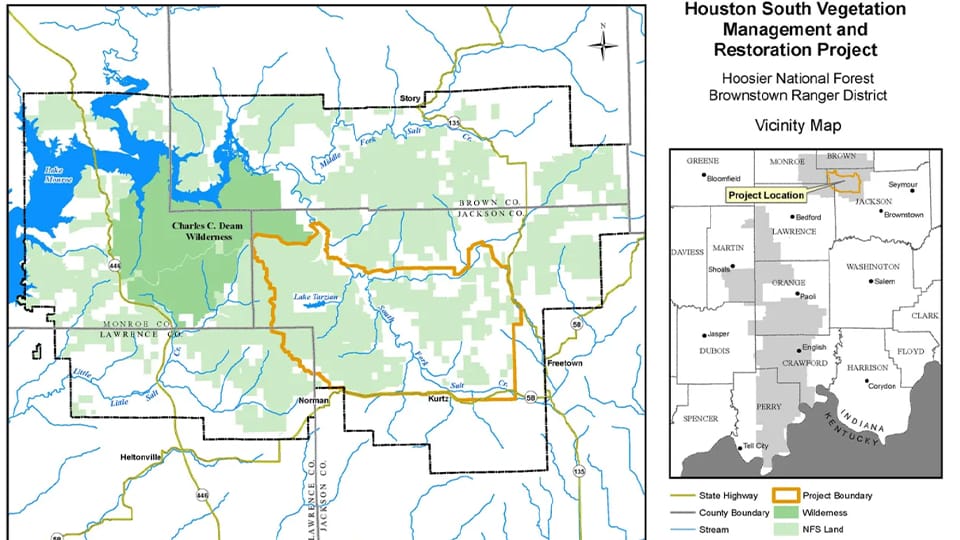
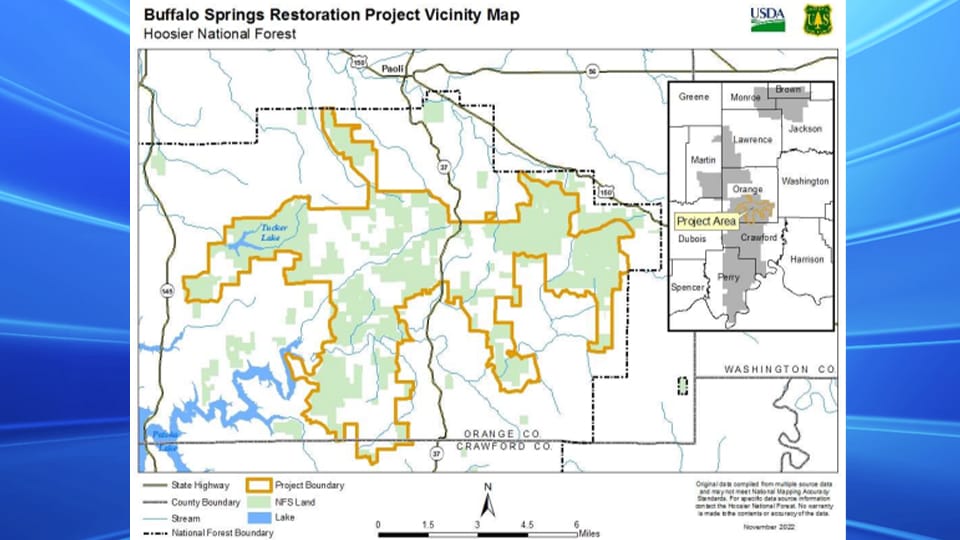
The USFS auctioned off a 39-acre timber plot this month. The sale signals the start of the Houston South restoration project, which—along with the proposed Buffalo Springs restoration project—calls for controlled burns and logging on close to 38,000 of the Hoosier National Forest’s 204,000 acres over a 15-year period.
The USFS declined to comment through a spokesperson. Hoosier National Forest District Ranger Chris Thorton explained the forest service’s rationale for the measures in a letter dated March 5.
“The [Houston South project] will ensure a healthy and sustainable forest for the future by restoring native ecosystems and improving the forest’s resilience to the threats posed by climate change, non-native species, insects and disease,” Thorton wrote. “Inaction is not a viable option for ensuring long-term forest health and sustainability. There is no option available that ‘lets nature fix itself.’”
But as the grand plan moves forward, there are a number of environmental organizations opposed to the federal agency’s approach. The main point of contention is whether the forest should be left untouched or actively managed, with the Indiana Forest Alliance calling it “the largest and most destructive” project in the forest’s history.
Joining the forest alliance in opposition are the Friends of Lake Monroe, the Hoosier Environmental Council and local units of government who say getting rid of trees will lead to erosion and damage the water quality in Lake Monroe, which provides water to over 100,000 people.
The groups have sued, unsuccessfully, hoping to stop the Houston South project getting underway this year.
“We believe our publicly owned forests are far more valuable for their biodiversity, recreational opportunities, heritage and history, as well as their role in providing clean air and water, absorbing carbon, and moderating weather extremes, than they are for commercial extraction,” wrote former Indiana Forest Alliance executive director Jeff Stant in February.
Since he took office, Indiana Gov. Mike Braun has also waded into the debate, writing a letter to the forest service in the spring urging the USFS to reconsider the project.
Conservation vs. preservation
The Hoosier National Forest spans 204,000 acres across nine counties in southern Indiana, and forest service staff are proposing similar methods in two different areas to make the ecosystem more sustainable.
The Houston South project covers a little less than 18,000 acres, all of it in the northeast section of the forest, mostly in Jackson County. Meanwhile the Buffalo Springs project deals with about 20,000 acres, almost all in Orange County.
In both areas the USFS plans to clear out 4,000-5,000 acres through logging and other practices. Then on the remaining 13,000-15,000 acres on both sites, there will be controlled fires.
The Houston South project is moving forward this year, though the forest service says a final decision the Buffalo Springs project hasn’t been given final approval.
Perry Seitzinger graduated from Purdue University with a degree in forestry and has been in the forestry business for close to 25 years. He mostly works for private landowners, but he’s familiar with the USFS’ work in the Hoosier National Forest and says it’s well-founded.
Seitzinger explained that early settlers in Indiana cut down huge swaths of original oak and hickory forests to clear the land for agriculture. In areas where forests have come back, shade-tolerant species like beach and maple are winning out, which is having a detrimental effect on the overall health of the forest and wildlife.
“If we want our forests to be how they are now, knowing that they’re a direct result of large-scale disturbance, then passive management is no longer an option,” Seitzinger said.
He added the forest service will plant new oak and hickory trees in areas that are cleared, leading to a healthier mix of young and old trees.
Project scale
Proponents of the USFS plan understand the total scope sounds daunting. But they emphasize work will happen over the course of 15 or more years, and new trees will be planted in areas that are cleared out.
In a March 5 letter posted to the forest service’s website, Hoosier National Forest Supervisor Mark Chaveas said the planned timber operations wouldn’t be any more than what happens regularly. If both projects were to move forward, about 0.3% of the forest would be harvested for timber annually over the next 15 years.
And while it may sound antithetical to conservation to allow logging in the Hoosier National Forest, Ray Moistner of the Indiana Hardwood Lumbermens Association says the reality is environmentally sound.
As opposed to large-scale industrial operations on private land, Moistner said logging on public land yields very little profit for timber companies. Permitting can take years, and a large percentage of harvested trees have diseases or are otherwise unfit for commercial use.
That lack of enthusiasm seems to be reflected in only one company—Paoli-based Andis Logging—submitting a bid for the 39 acres of land auctioned off last week.
Moistner says the forest service’s plans for the Hoosier National Forest will help the lumber industry in the long run by creating healthier forests in the region.
Still, the forest service’s plans have been contested in federal court numerous times. The main thrust of the lawsuits was that the USFS didn’t perform adequate studies on the effects of the Houston South project on the Lake Monroe watershed.
This year Indiana’s governor has also put pressure on the forest service to stop the projects. In Februrary Braun sent a letter to the USFS saying, “Since assuming office, the Trump administration has demonstrated a seriousness about re-evaluating decisions of its predecessors in order to achieve optimal results for the American people. With this in mind, I write to ask the USFS to immediately withdraw the Buffalo Springs Restoration Project in the Hoosier National Forest.”
Braun has penned legislation dating back to his time in the U.S. Senate looking to expand protections for Indiana forests. The governer also owns a 220-acre parcel of land about two miles from the Buffalo Springs project site. Campaign finance disclosures show Braun received over $40,000 in donations from Jeff Stant—past head of the Indiana Forest Alliance—during his gubernatorial campaign.
In response to the lawsuits, the forest service submitted further reviews saying the plans would have no significant impact on the water table. The forest service says its best practices include the use of “seeding, mats, water bars, silt fencing and reinforced stream crossings to maintain water quality.”
Though there are loud voices on the other side, supporters of the forest service say the projects are backed by science and will improve the health of the Hoosier National Forest.
“Let professional foresters manage the forest,” Moistner said.