
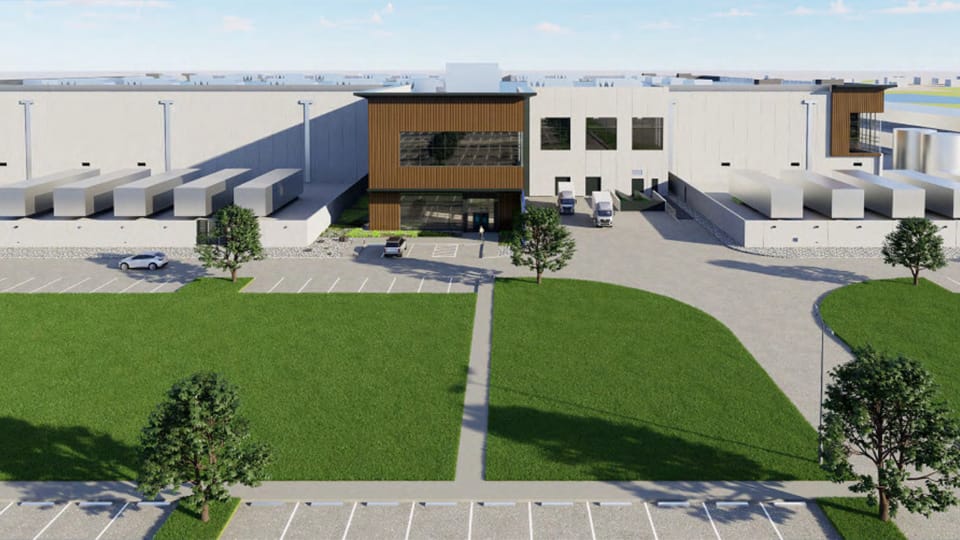
A Seattle-based data center developer and operator has filed plans with the city of Indianapolis to build a $4 billion, 250-megawatt facility in Decatur Township on the city’s southwest side.
According to plans, the two-building data center from Sabey Corp. would occupy a 130-acre site near the northeast corner of Kentucky Avenue and Camby Road. The property, owned by Indianapolis-based Strategic Capital Partners but under contract pending city approvals, was rezoned for industrial development in 2020 for a different project but requires variances to accommodate a data center.
In addition to two buildings, the project calls for a 10-acre substation that would ramp up to support the data center’s eventual 250-megawatt capacity over five years.
One of the data center’s buildings would be about 572,500 square feet, while the other would be a two-story structure of 490,000 square feet, according to preliminary site plans. The larger building, oriented north-to-south, would have a height of about 30 feet, while the smaller structure—constructed at a 15-degree angle—would be about 50 feet tall.
The bigger data center building would be completed by 2028, with the other finished by 2030, according to the plans. The project would also include five water detention ponds, a wetlands and dozens of trees, fencing and berms with 200-foot setbacks in certain parts of the property.
The project would create 100 full-time jobs for those managing its operations. Another 500 workers would be needed during construction.
Sabey owns and operates seven data centers across the United States, but the Indianapolis facility would be the largest based on power consumption. The company’s filings with the city’s Department of Metropolitan Development indicate that electric utility AES Indiana is supportive of the project.
In emailed comments to IBJ, a spokesperson for Sabey said the company is “not one of the large tech corporations that have previously sparked concern,” referring to Google, Meta, Amazon and other major companies that have sought to build data centers in Indiana.
Google’s plans for a $1.5 billion, 400-megawatt data center project in Franklin Township in the southeast corner of Marion County were quashed following community pushback earlier this year.
Sabey plans to hold a community meeting on its project Tuesday at 6:30 p.m. at Decatur Township School for Excellence. It has also established a website detailing the project plans.
“We’re a private, vertically integrated and family-owned company that hires locally and calls the communities we build in home, too,” said Teddy Otero, director of marketing and communications. “We’re committed to earning trust through transparent engagement, responsible development, modern efficiency standards, responsible power planning, and long-term partnerships (all of which we count among our core values).”
Sabey’s project would occupy parcels at 6400, 6449, 6455, 6500, 6559, 6600 and 6833 Kentucky Ave., and 6700, 7924, 7944, 8002, 8032 and 8210 Camby Road. The site does not include the direct northeast corner of the intersection.
The land had previously been earmarked for a 1.2 million-square-foot industrial park with six warehouses and retail. The site must receive two variances and modified zoning in order for the data center project to advance.
Because Sabey is requesting only a modification of the existing zoning—rather than a full rezone of the site—the matter will not be heard by City-County Council. Instead, it will be handled directly by the mayor- and council-appointed Metropolitan Development Commission.
When the rezoning was first approved, the zoning did not explicitly include a data center as a permitted use, nor did it allow for a development with a minimum of 200 parking spaces—the company’s target figure.
The company is seeking approval for modification to the commitments on the site to accommodate its project, including alterations to the maximum building height, a new commitment to use a closed-loop water system and modifications to items on the site’s development, landscaping and right-of-ways.
Sabey’s data centers are generally considered co-location facilities, which means the properties are leased by multiple companies and organizations for different uses. Otero said those users could include hospitals, schools and transportation companies, along with financial institutions and government entities. While some users may adopt artificial intelligence, most use the facilities to support their cloud computing services.
According to the filings, Sabey would spend about $2 billion to $3 billion in land acquisition, site development and construction, while tenant buildouts would be another $1 billion to $2 billion for servers, networking equipment and other high-end hardware that could support artificial intelligence. The total anticipated investment would be about $10 million to $15 million per megawatt.
The project is expected to use a closed-loop water system—a design generally considered more environmentally friendly than open-loop systems. Each building would initially require about 500,000 gallons of water, with another 100,000 to 150,000 gallons each year, which the company said is the equivalent usage of an office building.
According to the Environmental and Energy Study Institute, a medium-sized data center consumes up to 110 million gallons per year.
City-County Council member Josh Bain, a Republican who represents southern Decatur Township, said he’s still learning about the project and hasn’t decided yet whether he will support it.
But he said the company has “been pretty transparent so far” and has agreed to several of his requests already. That includes plans for a community meeting and agreements to implement a closed-loop water system and to develop on a site that’s already zoned for industrial uses.
He said the Sabey has also committed more than $5 million that could go toward community projects ranging from infrastructure to parks to programming.
“We look forward to bringing lasting benefits to this region—good jobs, local investment, and community partnership,” said Sabey’s Otero. “Our goal is to be more than a business neighbor; we want to contribute to a stronger local economy and a more connected future.”
Otero did not respond to an emailed question about the company’s plans to seek incentives for the project, but it is likely it will do so. Most recent data center projects in Indiana have received tax abatements for their land, as well as exemptions on personal property like equipment through a state law passed in 2019.
IBJ reporter Taylor Wooten contributed to this story.