
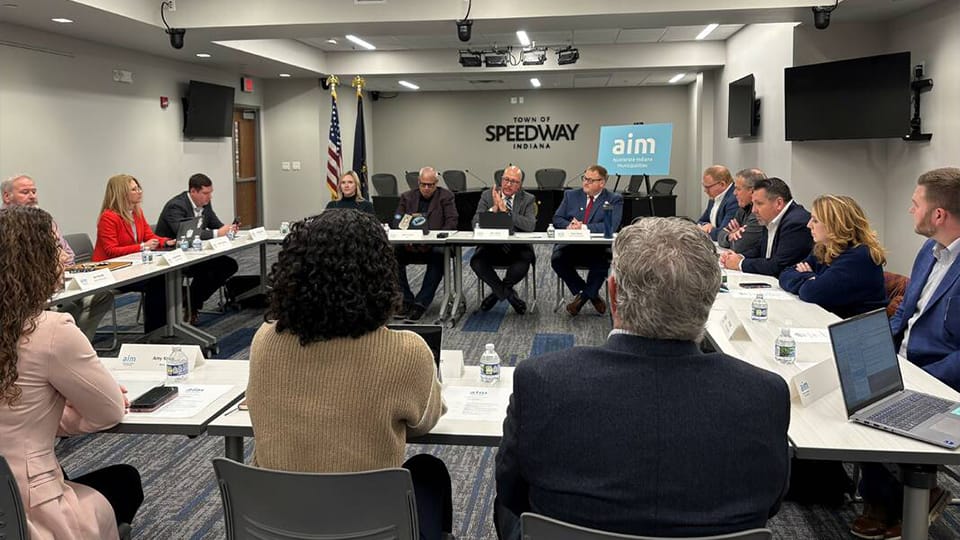
Diminished budgets, staffing reductions and postponed projects were the focus Wednesday as more than a dozen Hoosier mayors and town managers gathered in the Speedway Municipal Center to discuss the effects of Indiana’s new tax system.
The meeting was organized by Accelerate Indiana Municipalities, or AIM, as one of nine scheduled roundtables the group is holding to advertise its desired fixes to the new tax law ahead of the next legislative session.
AIM leaders emphasized the organization isn’t trying to “unring the bell” and ask for lawmakers to reverse property tax cuts. Instead, AIM President and Mishawaka Mayor Dave Wood said local communities want more clarity and control over their financial situations.
“Towns and cities are being asked to do more with less, but at the same time we’re being stripped of the tools to be able to do more with less,” Wood said.
The municipal advocacy group is calling for a series of tweaks to the tax law as currently written, but AIM CEO Matt Greller emphasized three main goals to local leaders and reporters Wednesday:
- Reduce income tax rate for county governments and increase income tax rate for municipalities
- Remove the requirement for municipalities to approve income tax rates on an annual basis
- Give municipalities with fewer than 3,500 people more say over income tax rates
“With those main changes, every town would have a path, by working with local town and county councils, to recoup where they’re at today,” said Campbell Ricci, AIM’s policy and financial resources director.
Proposed changes
The tax law—which local officials refer to as SEA 1 for its bill number in the 2025 session—is expected to lead to about $1.3 billion in property tax savings for Indiana homeowners over the next three years thanks to a 10% property tax credit for homeowners that is capped at $300.
The changes under the law have caused towns to delay or abort infrastructure improvements and equipment purchases and have caused hiring freezes or layoffs in most local governments outside of public safety. Columbia City Mayor Ryan Daniel emphasized quality-of-life projects will suffer the most as a result of the law.
“We’re continuing to hear from our friends at the Statehouse that they’re focused on population growth and focused on economic development,” Daniel said. “The challenge is, if you take away those quality-of-life services, if you take away those amenities, they’ll be less likely to have people to stay in our communities. Which means there will be less workers for those development opportunities.”
To offset the property tax decrease, legislators significantly changed Indiana’s local income tax system. The law allows cities with more than 3,500 residents to adopt income tax rates of up to 1.2%. Previously, income taxes could be levied only countywide.
But lawmakers also voted to limit the total income tax rate that could be collected at the local level (with city, town and county rates combined) to 2.9%. That’s down from a previous county limit of 3.75%—and could render moot the option for some cities and towns to levy their own tax rates.
After conducting an analysis, AIM estimates that more than half of Indiana towns will actually lose income tax revenue starting in 2028 when the changes take effect.
“It gives municipalities more control over our own income tax rate, however we’re still going to have a significant shortfall,” said Plainfield Town Manager Andrew Klinger, who estimates Plainfield will see $3 million to $4 million less in income tax revenue in 2028 if the law isn’t amended.
As it currently stands, the 2.9% local income tax breakdown allows for 1.2% to go toward the county, 1.2% for a city or town, 0.4% for fire and EMS services and 0.2% for townships units.
That adds up to 3%, but Ricci, AIM’s policy director, explained that most counties and townships don’t max out their tax allotment to keep the number under the 2.9% cap.
Ricci said most counties could keep their revenue even with a rate much lower than 1.2%. Given that, AIM is asking lawmakers to rewrite SEA1 to shift the breakdown to take revenue from county governments and fire territories and reallocate it to municipalities.
AIM’s proposed breakdown is: 0.7% for counties, 1.9% for municipalities, 0.2% for fire and EMS and 0.2% for townships.
A clearer picture
AIM would also like to see changes to income tax approval mechanisms before they take effect in 2028.
At that point, municipalities would need to approve their income tax rates each year, and if no vote were held, the rate would drop to zero. That lack of year-to-year stability could decrease the bond rating of many Indiana municipalities since it creates uncertainty for investors.
“It’s very hard to bond against that because when a body has to adopt a rate to pay that bond each and every year, it’s very difficult to talk about financing that debt,” Greller said. He noted that, as currently implemented, a procedural snafu like too many city councilors being out of town for a key vote could cause the town’s income tax rate to go to zero.
Instead, for any year when a city doesn’t change its income tax rate, AIM is asking for the rate to stay the same as the previous year.
In addition to removing the year-to-year uncertainty, AIM would like smaller towns to have a larger say in their income tax system.
Currently, Indiana towns with fewer than 3,500 residents are subject to the county’s income tax rate and have no say in setting that number. AIM is asking for towns of up to 34,000 residents to be given seats on a local income tax board that sets rates alongside unincorporated areas. Seats on the board would be proportional to population.
Whether legislators will agree to any of AIM’s proposals is uncertain. Some legislators have signaled early signs they’re willing to revisit the massive tax changes.
In September, the Indiana Capital Chronicle reported that Sen. Travis Holdman, R-Markle, said he’s considering changes to the tax law, possibly including postponing the effective dates for some of the bill’s provisions. Holdman chairs the Senate Committee on Tax and Fiscal Policy.
As he has for the past few weeks, Greller said he’s “cautiously optimistic” legislators are willing to address concerns over the tax system.
“I think the conversations we’ve had with legislators that have been ongoing all summer have been really good,” Greller said. “It’s a learning process. Legislators, just like we do, have to learn the process and understand what was passed and the intricacies of how everything works together. I do think there is momentum to fix some of those things.”