
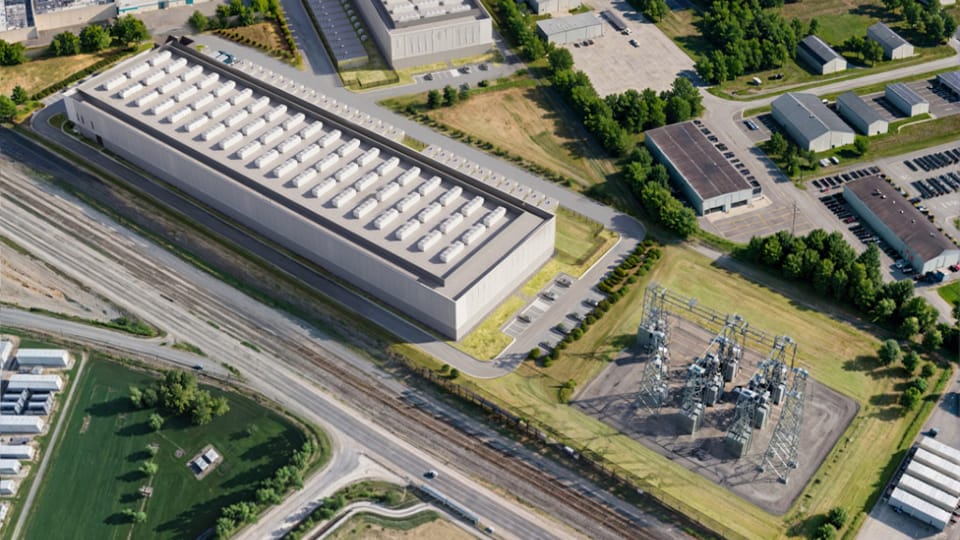
The firm behind a proposed data center in the Martindale-Brightwood neighborhood of Indianapolis has submitted its request to city officials to rezone nearly 14 acres of land for the project.
The rezoning application to the Department of Metropolitan Development shows that Los Angeles-based Metrobloks intends to build two large buildings, a pocket park and a power substation on a 13.68-acre parcel at 2505 N. Sherman Drive. The firm’s filings also outline the facility’s usage of energy and water, which the company contends are minimal.
To build the campus, Metrobloks wants to rezone the land from an I-2 industrial classification to a C-S commercial classification. It is also seeking variances to regulations that would allow a maximum building height of 70 feet, the removal of a maximum setback requirement, and a minimum of 60 parking spaces.
The $500 million campus would be built in two phases, Hope Martin, design manager for Metrobloks, told IBJ in an email.
The first phase would represent about half of that budget and include a smaller data-storage building on the northeastern portion of the site. That building will use about 28% of the estimated 75 megawatts of power the campus is expected to require. A larger building abutting the CSX rail line would be built in a second phase. That phase will cost about $250 million and is expected to use the remaining 72% of the project’s estimated power needs.
Company vows not to raise local utility rates
The mostly vacant property—a fenced space between Sherman Drive and Brightwood Plaza—served as the site of the Sherman Drive-In until 1983. The property currently is owned by Indianapolis-based Sherman Investments LLC. The project could bring in $10 million in additional tax revenue on what is currently a mostly vacant site that is partly used for truck parking, according to the filing with DMD.
The facility would use a closed-loop water system, meaning water used to cool hot servers stored in the buildings could be recycled. Because of that, it would use less water than the average household in a year, Metrobloks CEO Ernest Popescu told IBJ.
According to documents submitted to the Department of Metropolitan Development, the facility would use between zero and 3,325 gallons of water per year. (According to the Environmental Protection Agency, the average American uses 82 gallons a day at home. That’s equivalent to about 30,000 gallons a year.)
That method does require a heftier water draw upfront. Metroblok’s filing shows that it would initially use 66,500 gallons of water to fill the system. That wouldn’t be pulled from groundwater sources, the company says.
Metrobloks would pay for any necessary upgrades to infrastructure and purchase electricity through long-term agreements with AES Indiana or through the wholesale market.
“We will not raise your electric or water bills,” Metrobloks wrote in a list of commitments to the community. The company also commits to “invest in the community outside our fence line,” and “continue open conversations.”
The planned 75 megawatt plant is a fraction of the size of some large-scale data centers, such as the proposed Amazon data center in New Carlisle, which is anticipated to use 2,250 megawatts. AES Indiana’s planned Google data center in Morgan County will require a 1,200 megawatt substation, but the company hasn’t publicly shared the usage.
Metrobloks also commits to “offering park improvements, public art or murals and local workforce development,” as part of the project.
A date for the first hearing on the rezoning case has not yet been set, according to the DMD.
Community pushback
The project has received substantial community pushback despite being a much more low-key project than the hyperscale data centers that have recently made headlines. A consumer advocate group that deals with utility costs says the project is smaller but the impact isn’t insignificant.
Ben Inskeep, program director with consumer advocacy organization Citizens Action Coalition, said that the 75 megawatt facility “is still a very large load” in a traditional electric utility context, similar to the use of a large industrial facility like an ethanol production plant or a Rolls-Royce jet engine testing facility. He said it is smaller in the context of other data centers, which he called “unfathomably large” users of electricity, “of a magnitude we’ve never seen before.”
Inskeep also told IBJ that Metrobloks’ claim about electricity use is misleading.
“There are not policies in place to protect AES Indiana residential customers from potential utility bill increases from a data center like this, and it is irresponsible for them to imply otherwise,” Inskeep wrote to IBJ in an email.
AES Indiana’s rates are set by the Indiana Utility Regulatory Commission. The IURC is currently contemplating an AES Indiana rate hike.
Metrobloks: Opponents ‘paint all data centers with the same brush’
Opponents of the project have held multiple community meetings and staged a protest near the site with more than 100 attendees.
Even before the documents were officially submitted, community leader Jacklyn McMillan Gunn told WFYI that her organizations—One Voice Martindale-Brightwood and the Hillside Neighborhood Associations—will oppose any request Metrobloks makes to city development officials.
Popescu told IBJ in a recent interview that opponents unfairly equate the small-scale data center with a massive, 400-acre project from Google on the city’s south side. Ultimately, Google pulled that project after it appeared that Indianapolis elected officials would not support it.
“We took it upon ourselves to be open and transparent, and unfortunately, I think our data center is being treated the same as Google’s data center when it’s an entirely different project,” he said. He added that “a very small group of isolated individuals within the community are not keeping an open mind, and they’re painting all data centers with the same brush.”
An attorney representing Metrobloks initiated discussions with Martindale-Brightwood residents through a September email, which McMillan Gunn distributed widely to press and community leaders.
Popescu argued, and documents submitted by Metrobloks bear out, that it would likely be a better neighbor than the hyperscale data centers built by companies like Google and Meta in terms of water and electricity use.
It will also create dozens of local jobs for the 18- to 24-month construction process, the documents say. Data centers aren’t typically large job creators. Popescu said the project would ultimately create between 50 and 100 permanent jobs.
IBJ’s Marek Mazurek contributed reporting to this story.