
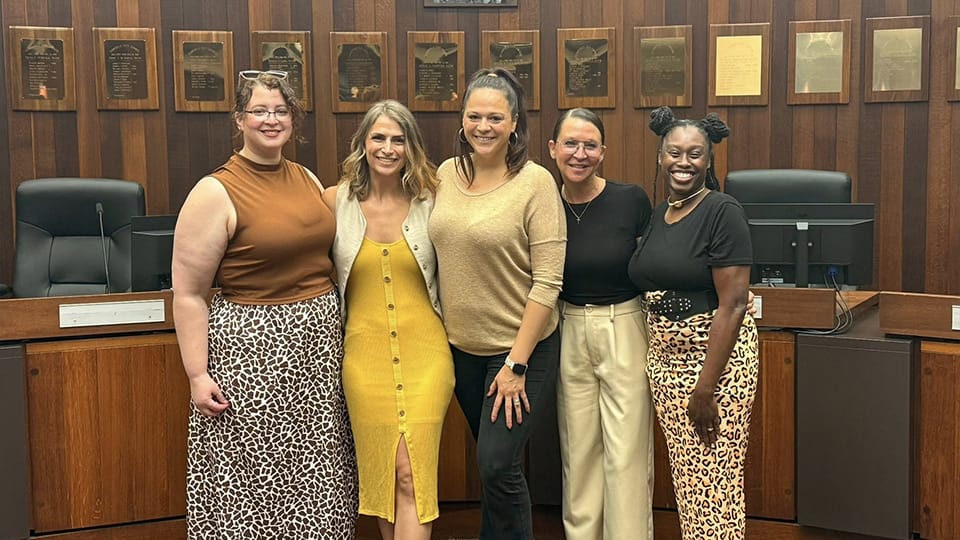
Nearly two years after the creation of CDFI Friendly Evansville Region, the nonprofit is making steady progress in providing underserved communities with access to capital.
Executive Director Taylor Price said the organization has been helping small business owners and other nonprofits connect with community development financial institutions to finance projects. In addition, a program for emerging developers called Jumpstart EVV, which started in September, will wrap up in November.
“[The program covered] a wide variety of topics from how to get started, getting off the ground, understanding the need in the area, writing a business plan, understanding your credit, zoning permitting, sheriff sales, writing a pro forma, how to select a contractor, everything. And then once the graduates finish the program, they receive a certificate and are paired with seasoned mentors,” Price said.
The nonprofit, along with other CDFI-friendly organizations in Indiana and across the country, continues making connections in underserved communities despite CDFI Fund layoffs at the federal level in early October. A judge indefinitely blocked the government shutdown-related terminations a few weeks later.
“The CDFI-friendly model is a much more efficient way for CDFIs to originate loans,” said Mark Pinsky, president and founder of CDFI Friendly America. “So there’s a lot of interest in what we’re doing in Evansville and Bloomington and South Bend and Tulsa and Fort Worth and other places where we’re working now, because it’s a way that helps them serve their mission and earn the revenue that they need to earn off their lending. So no one’s worried about the CDFI industry.”
‘We keep pushing forward’
CDFI Friendly Evansville Region partners with more than 20 CDFIs, including several entities that focus on small businesses. Price believes that if the federal layoffs are allowed, the terminations won’t have a huge impact on the organization’s efforts in southwest Indiana.
“Many of the CDFIs that I work with and serve the Evansville region, a lot of them don’t rely solely on the CDFI Fund for their funding. Some of them don’t rely on it at all,” said Price. “I would say for some CDFIs that do rely on it more, we won’t see as much investment.”
However, a new rule from the U.S. Small Business Administration requiring citizenship verification for loan applications is affecting the nonprofit’s ability to help immigrants get SBA lending. As Price navigates that challenge, she continues to support the CDFI Fund’s federal mission.
“We keep pushing forward. We keep lobbying. We keep writing letters to Congress. Self-care these days is writing letters to my senators and doing everything we can to advocate for [the CDFI Fund]. I never thought, whenever coming into this role, that politics would be part of my job, but here I am,” Price said.
Price theorizes that the CDFI Fund layoffs are part of the Trump administration’s banishment of diversity, equity and inclusion initiatives and misconceptions about CDFIs.
“They’re under the assumption that CDFIs only lend to protected individuals—minorities, women, veterans, people with disabilities, everything sort of DEI-related—when CDFIs are for everyone. It’s disheartening,” said Price.
IFF’s work in the region
IFF, a full-service CDFI that serves Indiana and eight other Midwestern states, provides loan capital to nonprofits for facility projects. Amandula Anderson, the Indiana region’s executive director, explained that the institution also serves critical community sectors.
“Childcare, affordable housing, schools, health care and anyone bringing access to food. So you may not technically be a nonprofit to benefit from IFF’s work. However, these are all mission-driven organizations that are heavily involved in helping communities to thrive,” Anderson said.
IFF recently teamed up with Evansville’s Dream Center, which provides place-based cradle-to-career services in the Jacobsville neighborhood.
“We provided them with a loan to acquire some adjacent property because they’re expanding their mission to meet the need for affordable housing in their community,” said Anderson. “Our real estate consultancy also worked with them to build out a plan for the best approach in doing that work in building those homes or rehabbing those homes that are adjacent to the Dream Center.”
Anderson said IFF has been collaborating closely with Price and her organization as part of the institution’s goal to reach every corner of the state.
“What that means is me spending time in communities and listening and helping to make the connection or referral to the next tool or resource that will help those organizations realize the strategic plans that they’ve developed,” said Anderson. “The real goal for us is that a community has a need that’s right now, present, and we’re able to use and leverage our balance sheet to help that community access that need and provide the programming and services immediately.”
What’s next
Because IFF is a large CDFI, Anderson believes the entity won’t be greatly impacted if the CDFI Fund layoffs come to fruition.
“Our funding sources, the tools that we use to loan to the nonprofits, we’re able to regenerate those dollars to continue to support more communities. For some of the smaller and newer CDFIs that focus more on small businesses, that could be a challenge in helping to unlock capital for those small businesses to continue to grow and expand if the CDFI fund were to adjust in some drastic way,” said Anderson.
Despite the federal uncertainty, Anderson emphasized that IFF remains committed to continuing CDFI work in southwest Indiana.
“What we want to encourage is that continued communication with Taylor, the CDFI-friendly folks, reaching out to me or other CDFI partners who have invested in the Evansville area to show that we’re here. We want to help [people] unlock their goals and their missions,” said Anderson.
Pinsky believes the CDFI Fund is too important to the economy to be dismantled. Since 2005, he said the CDFI Fund has invested a fair amount of money into the CDFI industry, which in turn has made more than $243 billion of investment in all 50 states.
“The CDFI industry has grown at least 20% a year for the last 40 years, which is a crazy, ridiculous statistic if you ask anybody in any industry. And so maybe this year it grows at 5% or 10%, and next year it grows at 5% or 0%. It’s not going away. It’s not in danger. The CDFI industry is going to continue doing what it’s doing,” said Pinsky.