
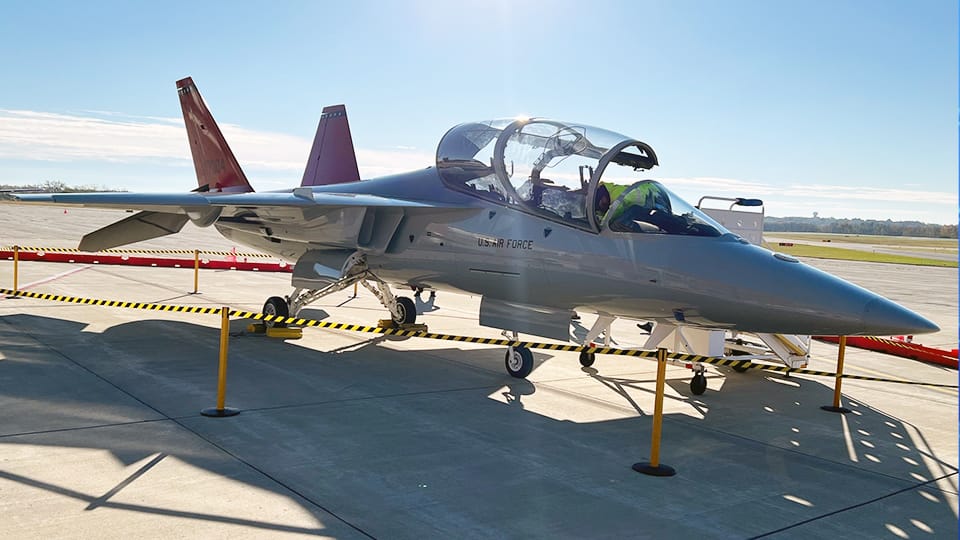
Executives from Sweden-based Saab and Virginia-based Boeing gathered at Purdue University Airport on Thursday to celebrate their collaboration to build and deliver the T-7A Red Hawk advanced trainer aircraft for the U.S. Air Force.
Just over four years ago, Saab cut the ribbon on a $37 million research and manufacturing facility at Purdue’s Discovery Park District to produce the aft section for the new aircraft.
Once the aft sections are built, they are shipped to Boeing’s facility in St. Louis where final assembly is completed, and the company plans to deliver its first operational aircraft to the Air Force in early December.
Saab CEO Micael Johansson told reporters that Saab is ready to ramp up production at the West Lafayette facility to manufacture 350 aft sections over the next decade.
“This is a success story in terms of technology transfer, and now I just continue to look forward to the partnership with Boeing to make this a great success going forward,” Johansson said. “It’s a long-term program. Many aircraft will be delivered.”
Johansson said the 100,000-square-foot facility currently employs about 240 people, and the company has room to expand both in terms of personnel and production space.
The T-7A Red Hawk is an advanced pilot training system designed for the Air Force to train the next generation of combat pilots. Steve Parker, CEO of Boeing Defense, Space & Security, said the aircraft features fully digital displays and, as a fighter craft, can perform the types of maneuvers that its predecessor couldn’t.
“It’s a different level of performance and a different level of capability,” Parker said.
The aircraft is also connected with simulators used by the Air Force, allowing trainees to see how the plane is operating in real time. Parker described it as a “revolutionary training system and capability that’s going to last 40 to 50 years and change the game.”
In early 2024, Saab received a nearly $102 million award from Boeing to product the aft sections of the aircraft.
Johansson said while the West Lafayette facility is currently in a low-rate initial production stage, his company is ready to increase its efforts, which could go beyond just the order made by the Air Force.
“Many countries are interested in this,” he said. “In that case, of course, we would expand. We have lands. We can build more facilities here and ramp up even further.”
Parker said both companies see a market where 2,000 to 3,000 aircraft could be produced over time, but they are also focused on the task at hand.
“We’re excited for the future,” he said. “[But] right now, it’s all about making sure that we get the United States Air Force the best training aircraft and start to build them out, and I think the additional orders will come.”
Johansson also praised Saab’s relationship with Purdue, and said there is more research being done beyond just the T-7A aircraft that makes the partnership with the university special.
“We have many avenues of research going with Purdue,” he said. “I want to make this the U.S. aeronautics site for Saab, so I want to go beyond production, and hopefully we can find more partnerships to do things together. And then I need the skilled engineers from Purdue.”
Boeing plans to deliver the first T-7A Red Hawk to Randolph Air Force Base in Texas on Dec. 5. You can learn more about the aircraft by clicking here.