
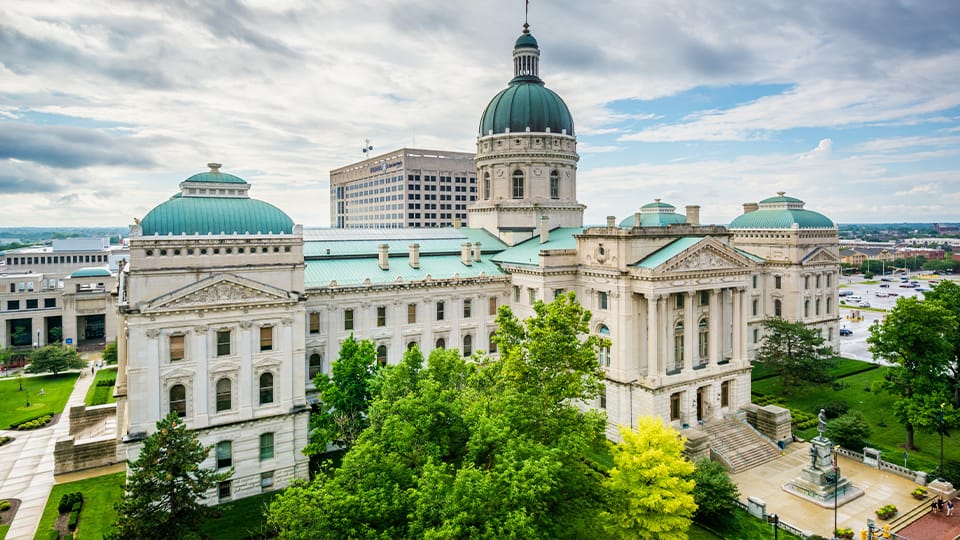
Gov. Mike Braun on Monday plans to sign a proclamation calling a special legislative session for the General Assembly to convene on Monday, Nov. 3, “to consider altering the boundaries of Indiana’s congressional districts,” his office announced.
Monday morning’s announcement confirms a report published by IBJ on Saturday.
The governor said the lawmakers would also “consider resolving an important issue regarding federal and state tax compliance that must be addressed.”
“I am calling a special legislative session to protect Hoosiers from efforts in other states that seek to diminish their voice in Washington and ensure their representation in Congress is fair,” Braun said in a written statement. “I am also asking the legislature to conform Indiana’s tax code with new federal tax provisions to ensure stability and certainty for taxpayers and tax preparers for 2026 filings.”
The expected move follows months of lobbying by the Trump administration for Indiana to redraw its congressional map before the 2030 Census. Currently, seven of Indiana’s nine districts are represented by Republicans, and advocates of redistricting say that new maps could give the GOP a strong shot at all nine seats.
Discussions over redistricting heated up in the past two weeks with Vice President JD Vance visiting Indianapolis to meet with Republican lawmakers for a second time and Trump himself calling in to Republican senators Oct. 17.
Last Wednesday, Senate President Pro Tem Rodric Bray’s office put out a statement saying “the votes aren’t there” for redistricting. Since that statement was reported, four Republican senators—Scott Alexander, Muncie; Ron Alting, Lafayette; Justin Busch, Fort Wayne; and Daryl Schmitt, Jasper—released statements saying they support redistricting.
Molly Swigart, a spokesperson for Bray, said in a short statement on Monday, “the votes still aren’t there for redistricting.”
A spokesperson for Speaker of the House Todd Huston released a short statement saying, “We’ve received the Governor’s call for a special session and will continue having conversations within our caucus and with our counterparts in the Senate on our next steps.”
The spokesperson, Molly Gillaspie, told reporters the Indiana house has enough votes to pass redistricting.
Democrats in the Statehouse, meanwhile, continue to rail against redistricting efforts. Rep. Ed DeLaney, D-Indianapolis, emphasized that liberal voters are already underrepresented in congressional maps as Democrats hold just over 20% of Indiana’s Congressional seats, but garnered almost 40% of votes cast in the 2024 general election.
“They don’t want to say what they’re doing, which is basically trying to hijack a bunch of seats in the U.S. Congress and eliminate one of the two political parties from our congressional delegation,” DeLaney said. “The 40% of people who vote Democrat in the congressional races, even in bad years, will be told, ‘There’s no one to represent you, and no one should represent you.’”
In addition to redrawing Indiana’s Congressional maps, Braun said the special session will address recent changes to federal tax law that affect Indiana state tax filings.
“Addressing this discrepancy through a special session will provide taxpayers, accountants, and businesses the confidence and clarity ahead of filing season, avoid amended returns and filing delays, and continue the Indiana Department of Revenue’s strong record of fiscal management,” the announcement said.
Indiana last held a special legislative session in 2022 to pass a near-total abortion ban. That session cost taxpayers about $240,000.