
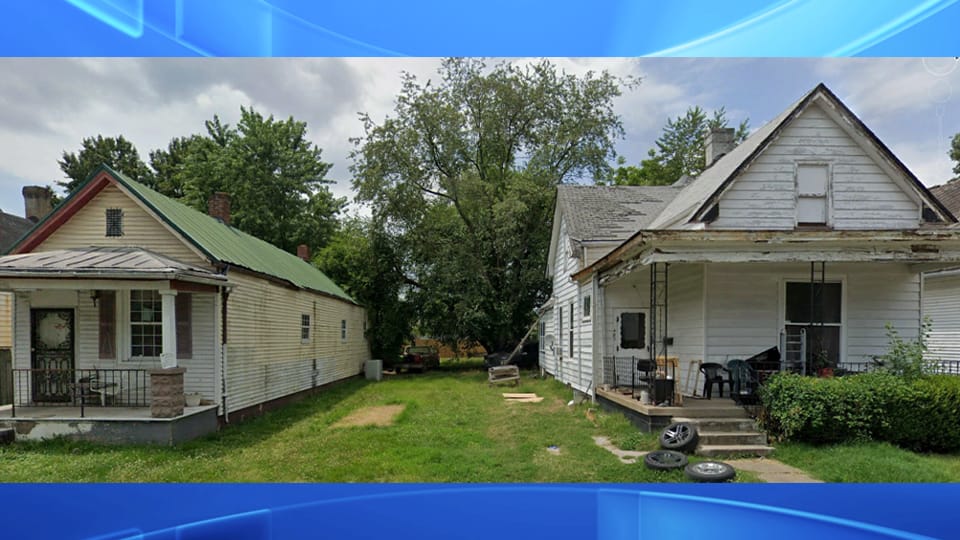
The Evansville Department of Metropolitan Development has hired a community planner to carry on the blighted property revitalization project started by a Harvard University Fellow over the summer.
Savalee Tikle, a Harvard Graduate School of Design student, spent 10 weeks in Evansville working with the DMD to develop a database for identifying and ranking blighted, vacant and underused properties in the center city.
“Through block-by-block surveys, stakeholder interviews and a lot of walking under the Midwest sun, we developed a system to not only categorize blight but to reimagine vacancy as future housing, as economic spark, as possibility,” Tikle said in a LinkedIn post.
In January, the city’s new community planner, Wyatt Koenig, is expected to advance redevelopment conversations in the center city, with the eventual goal of scaling the project throughout Evansville.
“We’ve done some restructuring within the Department of Metropolitan Development and phased out positions through attrition, but then thought about, ‘What do we really need?’ And a community planner is a part of that, and it will help us look at how to do development more meaningfully,” said Mayor Stephanie Terry.
Bloomberg Harvard City Leadership Initiative
Tikle came to Evansville as part of the city’s participation in the Bloomberg Harvard City Leadership Initiative. DMD Executive Director Kolbi Jackson said Evansville was chosen for the innovation track of the program with a focus on neighborhood revitalization. The initiative enabled the city to apply for and secure a Harvard Fellow to enhance Terry’s Fight Blight project.
“We did ask the community to report any blighted or vacant properties to us via email, but, of course, you’re not going to capture the whole picture,” Terry said.
During her time with DMD, Tikle focused on properties in 10 neighborhoods within the center city.
“The end goal was for that intern to provide the city with the land inventory for undeveloped land, vacant and blighted properties, to look at ownership and acquisition and to try to figure out what’s the highest possible development for those areas,” said Jackson.
Tikle took on the project with a boots-on-the-ground approach to lay a foundation for a targeted development strategy.
“I started the whole process by engaging with the internal and external stakeholders, where I was trying to understand, ‘What is the landscape of vacancy and blight within the region? Are there any past efforts that were done to address this issue in any way?’” Tikle said.
Property findings
Terry said Tikle’s summer project revealed 104 blighted lots and 526 vacant parcels in Evansville’s center city, totaling 630 properties with development potential. Tikle also ranked the lots to help DMD decide how to direct its resources.
“Maybe this is a stage one blight property that does not require immediate attention. But this is a stage three blight property, which requires our attention first. That helped us categorize our attention and look at which is the prioritized blight zone that we need to focus on,” said Tikle.
Before Tikle returned to Harvard, she presented her property findings to a group of city officials, nonprofit leaders and developers.
“While we were looking at the analysis, we realized there are a lot of vacant land parcels right next to each other. So is there a possibility of collaboration, of amalgamation, of neighborhood revitalization as a strategy where all of these land parcels could potentially come together? And the land parcels stakeholders were within the room,” Tikle said.
Residential, commercial and mixed-use development opportunities all exist in the center city, according to Jackson. However, the restoration outcomes will depend on zoning restrictions, investor intent and community ambitions.
“If there’s a residential area…it doesn’t mean that there isn’t an opportunity for some sort of smaller-scale mixed-use development, like a small coffee shop or some kind of small grocery store that might be needed in the neighborhood,” said Jackson.
‘Amazing opportunity for the city’
In 2026, when Koenig picks up where Tikle left off, he’ll have some ideas to work with regarding the prospective transformation of 600+ underdeveloped properties.
“In my final presentation, I had these graphics and a few pictorial representations,” Tikle said. “That helped people in the room see what those vacant and blighted properties could be. Either a community garden or multifamily housing, single-family housing, a retail zone.”
Jackson said the field work that Tikle did is significant compared to the normal housing data the DMD receives annually.
“This is an amazing opportunity for the city. It’s unprecedented in the way that we were able to go out into the community on the ground to build this land inventory for the center city as a starting point,” Jackson said. “It will allow us to look at areas of the city strategically and focus our efforts on what is needed based on that real-time data.”
On the heels of the city marking 50 blighted property demolitions in 2025 this month, the DMD plans to work with Evansville Land Bank to acquire eligible, unsold properties from a recent tax sale and team up with nonprofit organizations, neighborhood groups and private developers to revitalize those lots.
“Taking down dangerous structures is only the first step,” said Jackson in a news release. “The true success of this program comes when we turn empty lots into homes…when families can build a future on what used to be blighted property.”
Residents can continue to report unsafe, vacant and abandoned properties to the city via email, as well as view a list of structures that have been razed or are contracted for demolition online.
“This city surprised me. It reminded me that transformation often starts in places overlooked,” Tikle said on LinkedIn.