
Regional business and community leaders gathered this week for the South Bend Regional Chamber’s annual update, where CEO Jeff Rea and Director of Economic Development Alyson Herzig outlined population and labor trends alongside an unprecedented wave of private investment reshaping the area’s economic landscape.
Rea framed the event as both a data-driven look at the region’s economic fundamentals and a survey of major development projects underway.
“We see this as a great opportunity every year to highlight what’s happening in the region,” Rea said. “We do that with a two-pronged approach. With data and what’s happening in the community from a project investment standpoint.”
The region draws from a broad labor pool, with roughly 1.1 million people living within a 45-minute radius. Cost of living remains a key competitive advantage, the chamber says, at 91.6% of the national average. Projections show that the working-age population is expected to grow by about 4,000 people between now and 2034, an encouraging sign for employers facing tight labor markets.
“With a lot of employers in the room, they’re most worried about finding workers. That’s critical for us,” Rea said. “Our labor force participation rate is lower than it was before the pandemic.”
One persistent challenge is the outflow of workers to neighboring counties. Roughly 45,000 residents commute elsewhere for work each day. Rea noted that capturing even a small share of those workers could make a difference.
Wages have risen 18.5% since 2020 but at 21%, inflation continues to outpace earnings. Revised population growth numbers have come in slightly lower than previous estimates and unemployment has ticked up modestly since pre-pandemic levels.
Construction, however, remains a bright spot, buoyed by large-scale projects that are pushing permit activity to record highs.
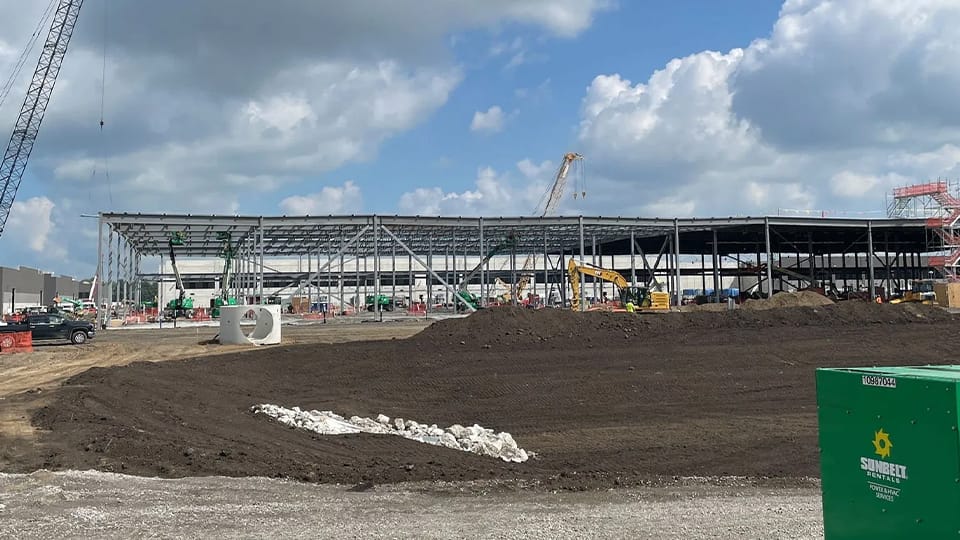
Much of the excitement centered on a series of transformative projects, including the $11 billion Amazon Web Services (AWS) data center campus and Synergy Cells, the electric vehicle battery production facility being developed by GM and Samsung SDI. Seven of AWS’s planned 32 buildings are already complete and construction is expected to continue for several years.
“Those salaries that they pay to those people get spent in the community,” Rea said. “It has a multiplier effect, so we really get a billion plus dollars of economic impact from those two companies every year.”
AWS in focus
The event featured a conversation with Brandon Oyer, AWS’ head of Americas energy and water, who sought to put the company’s energy and water use in perspective. Oyer noted that while data center expansion is occurring at a time of rising electricity demand, it coincides with larger structural shifts in the U.S. economy, like onshoring and transportation electrification.
To illustrate how deeply integrated data centers are into daily life, Oyer referenced a simple exercise shared during the event. Every time someone checks their bank account, streams a movie, shops online or watches live sports, they are relying on a data center, he explained.
“Data centers have become the modern backbone of everything that we do,” he said. “Just like when you walk in your house and it’s dark outside. You flip on a light switch, the lights will turn on.”
Oyer also addressed water usage, explaining that AWS uses water for cooling only a small fraction of the year. The company aims to return more water to communities than it consumes by 2030, a target it is already more than halfway toward.
“Right now in this region, we expect that the data center will only use water for 2% of the year,” he said. “There might be some information out in the public that we’re using water 24/7 and that’s just simply not the case.”
Oyer explains how the AWS data center in New Carlisle will use water.
If AWS draws from the aquifer beneath New Carlisle, part of the larger Kankakee Aquifer system for just 2% of the year, that amounts to roughly 175 hours annually. To ensure long-term sustainability, Indiana has set a safe withdrawal limit of 44 million gallons per day, with 24 million gallons allocated for all industrial users. Amazon’s permitted use falls within that industrial allotment.
He added that the diversity of the region’s economy was one of the most striking takeaways from the chamber event.
“It’s not just data centers that are causing infrastructure investment,” Oyer said. “Seeing how much investment and the growth that AWS will make, but then comparing it to other established industries was also eye opening.”
Oyer underscored that AWS views itself as a long-term community partner rather than an outside player.
“We look at South Bend, at New Carlisle, at the county, at the state, Hoosiers are our customers and employees,” he said. “As we make investments and build jobs, we’re also creating this flywheel for people to be a part of the community.”
Ongoing county-wide projects
Beacon Health System’s $230 million patient tower project announced in 2023 will add 54 ICU beds and create 300 new jobs, reinforcing the region’s role as a health care hub. Other developments include a $12 million expansion by GTA Containers in South Bend and a creative warehouse addition by United Pet Foods in Mishawaka.
The Morris Performing Arts Center in South Bend recently completed the second phase of its renovation, adding new bathrooms and concessions. Rea shared that the organization has selected a developer for a planned parking garage and apartments as part of phase three.
Large private investments have spurred a flurry of housing activity across the region. The Hedgecroft Village development in New Carlisle secured zoning approval for 500 units earlier this year. In Mishawaka, projects include the $41 million renovation of the 100 Center, the $50 million Stone Leaf Reserve affordable senior housing development, and The Mill at Ironworks Plaza.
Other notable developments include Diamond View Apartments near Four Winds Field and auto dealer Gurley Leep’s $240 million investment in a new facility. Notre Dame is also advancing its Tech and Talent Hub at the former South Bend Tribune site.
Steel Warehouse, the eighth largest private company according to IBJ research, recently installed a $20 million hybrid leveling system to expand operations.
Rea said the scale of development has ripple effects well beyond construction.
“We’re going to go through a period of time where every year is a record because of AWS and GM pulling permits at the same time,” he said. “AWS will continue to pull permits over the next couple years as they build out their full campus. So those will probably all be record setting years.”
Construction workers tied to the AWS and GM projects have boosted hotel demand across the area, contributing an estimated 73,000 hotel room nights this year, one of the best occupancy periods on record. Some contractors are opting to stay in hotels, while others are renting or buying homes for longer-term stays, providing a secondary lift to the local housing market.
“Big guys get a reputation sometimes, like they’re just sucking the money out of the community,” Rea explained. “But (AWS) has been very active with nonprofits and other organizations.”
The South Bend-Elkhart region benefits from a diversified economic base. Rea said 18% of residents work in health care, 13% in education, 11% in manufacturing and 10% in retail. Construction employs about 6% of the workforce, a number expected to grow as major projects progress.
“One of our pluses is this diversified economy we have,” Rea said. “It means that we ride the ebbs and flows of the economy a lot better. We don’t have all our eggs in the RV basket, we’re pretty balanced.”
Workforce trends and talent pipeline
Rea noted that Beacon’s expansion underscores health care’s continuing strength, while changing shopping habits could put pressure on retail employment. At the same time, property tax changes are expected to cut $175 million in local revenues, potentially leading to reductions in school and government employment.
Workforce development also remains central to sustaining economic momentum. Rea pointed to past and emerging public-private training partnerships as models for meeting industry needs. When GM built its H2 plant years ago, the company partnered with Ivy Tech to train its workforce, a strategy being mirrored in Kokomo’s Stellantis-Samsung EV project and locally with AWS.
“Developing that workforce is critical and two things need to happen,” Rea said. “We’ve got to build the workforce for today because they have some immediate needs. Then we’ve got to build the pipeline for tomorrow too.”
He added that AWS is taking an active role in introducing students to data center careers earlier in their education, a sign that employers are increasingly invested in shaping their future talent pipeline.
“Employers are really recognizing that they need to roll up their sleeves and get involved at a much deeper level to help ensure that they get their future workforce,” Rea said.