
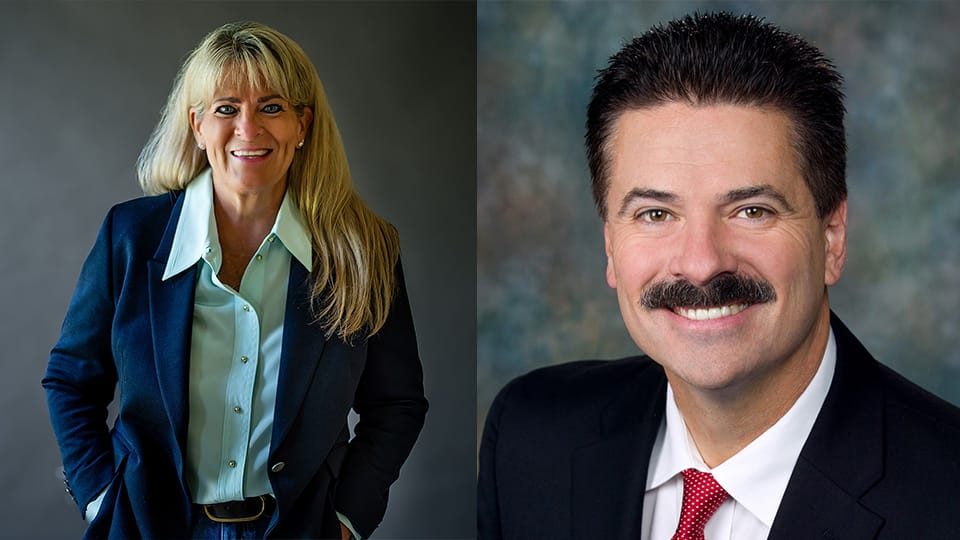
In October, the Indiana Historical Society will present Mead Johnson Nutrition with a certificate commemorating more than a century of business in the state. The infant nutrition manufacturer and Reckitt subsidiary celebrated its 120th anniversary at its U.S. headquarters in Evansville last month.
Susan Sholtis, global president of MJN, and Art Pike, MJN’s external relations lead, spoke with Inside Indiana Business about the evolution of the company and the future of infant nutrition.
This interview has been edited for length and clarity.
Tell me about the history of Mead Johnson Nutrition in Evansville.
Sholtis: It began with a father whose name was Edward Mead Johnson. His son was born with a condition that made it difficult to digest feedings. And [Johnson] worked day and night trying to create what became our first scientifically-based infant formula that saved his son’s life.
Evansville has been the home of our flagship manufacturing facility of our global [research and development] center, which also includes the Mead Johnson Pediatric Nutrition Institute. This makes Mead Johnson part of a small and elite group of businesses with deep roots in the state of Indiana.
When we celebrated our 120th anniversary at the Evansville facility, Governor Braun sent us some video remarks about the company during the event. He said Johnson pioneered the field of infant nutrition and has positioned Indiana as a leader in global nutrition science. We’re proud of that Evansville facility. It’s been a part of our culture and who we are for a long time.
What have been the biggest changes at the Evansville operation?
Sholtis: We have two different strengths or functions that operate out of that facility, not only production but also the R&D center. When it comes to manufacturing infant formula products, both of those things go hand in hand.
We’ve expanded our R&D operations along with our manufacturing capabilities over the last 120 years. And as science changes, our products have to change, too. That means our manufacturing facilities and R&D centers need to evolve as well. Because of Evansville, we have become a global leader in science-backed pediatric nutrition. That science is one of our strongest global differentiators as a company.
When you think about the city of Evansville and the diversity of the team we are pulling together, they come from all walks of life. From the highest-level scientists in the world to those who can help us manufacture the highest-quality product. It is a broad group of people with some incredible talent that we bring into that little town on the Ohio River.
We started 120 years ago with one formula, one solution. Now we partner, in particular at Evansville, with world-class researchers and institutions around the world to deliver a full suite of high-quality, science-based nutrition options for parents, including over 170 different products that come out of that Evansville facility.
What have been the biggest challenges for the Evansville facility?
Sholtis: It’s meeting the scale of demand. Everything that comes out of that facility has to be right 100% of the time. We cannot make mistakes in this business. We take it to heart. We take the infant’s health to heart. We take everything that we do out of that facility seriously.
The reason that I’m talking about the importance of quality and making sure that we’re meeting the feeding needs of the infants is because we responded to the unprecedented infant formula shortage that happened across the U.S. several years ago. Another company’s brand shut down a major infant formula factory for months. Accessing safe infant formula quickly became an overwhelming challenge for parents.
For us, it was a moment to step up, take action and meet the needs of the infants in the U.S. We operated every single facility we have around the world, including the one in Evansville, 24 hours a day, seven days a week. We increased the speed to market of our formulas by about 40%. And before long, we were providing essential nutrition to more than half of all the formula-fed babies in America.
Evansville played a significant role in closing that national supply gap. They ensured that families across the U.S. had reliable access to the formula that they depend on. Our workforce rallied and responded. One of the reasons we hold that Evansville team so near and dear is because they truly take to heart our purpose, which is nourishing infants and children for the best start in life.
Last year, the tornado that ripped through Mt. Vernon also ripped through our warehouse, which housed 60% of infant formula in the U.S. It took out all of our raw materials, all of our premixes, everything we send to our factories. Thank goodness, nobody was hurt in that tornado. But even without having all of that product and the raw materials to be able to send to the factories to start producing again, that Evansville team stepped up and delivered.
Our goal was to make sure none of the shelves went empty of our product. When unforeseen events happen, it takes extraordinary efforts to be able to ensure we’re doing our job, that moms and dads have the product they need and physicians can reliably recommend our product. That’s why I come back to our biggest challenge for our Evansville facility is constantly meeting the scale of demand, but meeting the scale of demand during unprecedented events.
What are some of the Evansville operation’s other successes?
Pike: Throughout our history, Mead Johnson has differentiated itself through its clinical science-based approach. We have leading research to better understand the nature of human milk and applying that knowledge to how we design our products, which we model after breast milk. Our innovations have benefited infants, children and families all over the globe.
Mead Johnson was the first in the U.S. to introduce [docosahexaenoic acid] into our formula. This is an omega-3 fatty acid that’s critical for infant brain and eye development and is now widely recognized as a standard of care for infant nutrition, among others.
What role does MJN play in Evansville’s economy?
Pike: Mead Johnson has been a significant employer, a long-standing corporate citizen and central to Evansville’s identity for more than a hundred years. Our presence has helped anchor the local economy and bring high-quality, science-based jobs to the community. Nearly 20% of our Evansville team has worked at Mead Johnson for 15 or more years.
I’ve been there 42 years myself, which says a lot about the culture as well as the pride people have in being part of something meaningful. Our mission is what makes us different. Scientific innovation and commitment to quality have helped Mead Johnson strengthen the Evansville economy and position us in the state of Indiana as a leader in global nutrition science.
We’ve hired thousands of local residents to work at Mead Johnson over the last century. We currently employ about 850 individuals with diverse skill sets and backgrounds across 25 departments on our Evansville campus. It’s more than just a workforce; it’s a legacy.
How does the Evansville facility attract employees in light of an aging workforce?
Pike: We continue to invest in training and career development to build our next generation of leaders. We continue to make the Evansville campus an attractive place to build a career in not only science and nutrition but also manufacturing. Supporting infant health worldwide is a unique motivator for our employees. About 44% of our current staff in Evansville is under the age of 40.
What does the 120th anniversary mean for the Evansville operation?
Pike: It was a real moment of pride when we celebrated—for the Evansville operation and for the company as a whole—to have built something impactful and enduring. Not a lot of companies can say they have a unique mission that has lasted for 120 years. It’s a celebration of both our legacy of innovation and the people in Evansville who make it possible. Our work benefits millions of families every year.
Our commitment to cutting-edge research and innovation and our rich heritage of feeding infants around the globe have earned Mead Johnson the trust of both parents and health care professionals worldwide. Enfamil is the number one infant formula brand recommended by pediatricians in the U.S., and Nutramigen is the number one recommended formula brand by pediatricians in the U.S. for managing infants who are allergic to cow’s milk. We’re proud of that.
What’s next for MJN in Evansville?
Sholtis: We’re making significant investments in research, innovation and production in Evansville. We are staying at the forefront of science-based nutrition to meet the needs of future generations. We’re proud to be building on 120 years of success to shape the next century and hope to continue to set new standards for health and wellness worldwide.
I had some colleagues say to me, “Susan, 120 years makes you sound old as a company.” And, yeah, 120 years is a long time, but it also means we’re good at what we do. Because companies aren’t around for 120 years feeding infants if they’re not good at what they do.
Our challenge and what is next for us is probably the most important task that we have. As I say to the teams when I have conversations with them during town halls or market visits, our job now is to set ourselves up for the next 120 years. What legacy are we going to leave for the people who are coming behind us to fulfill this important mission of feeding infants?
Reckitt has plans to sell MJN. How will that move affect the Evansville facility?
Sholtis: It will change the ownership of us as a company, and that’s a big deal. But we as an organization are dedicated to our mission of nourishing babies for the best start in life. And Evansville remains at the center of excellence for Mead Johnson. The importance of manufacturing quality products will not change.