
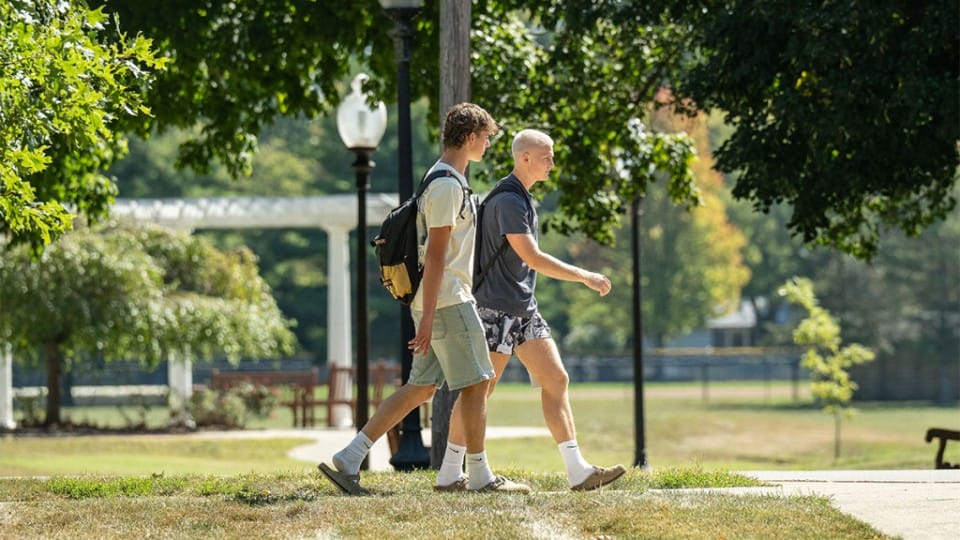
Go to many Indiana college campuses and peek in a classroom or stroll across the quad, and you might notice something.
There are fewer male students than female—often way fewer.
In raw numbers, 72,419 more girls than boys who graduated from Indiana high schools from 2009 to 2023 went on to higher education, according to the Indiana Commission for Higher Education’s College Going Dashboard.
That 15-year gender-gap total is roughly the same as the enrollment at Texas A&M’s College Station campus, one of the largest schools in the nation.
“I think the enrollment differential here in many places has risen to the level of disparate impact for boys,” said Michael Hicks, professor of economics and director of the Center for Business and Economic Research at Ball State University.
Women have attended college in greater numbers than men for decades, but the trend has heightened in recent years nationwide and in Indiana, where fewer Hoosier students overall are following the traditional path of college after high school.
Only about 52% of Indiana students who graduated from high school the previous academic year enrolled in higher education, according to 2023 data from the Indiana Commission for Higher Education released this year. That’s down from more than 61% in 2018.
As for male students, the recent data showed just 45% of 2023 Indiana male graduates enrolled in some form of training or education after high school compared with 58% of females.
The commission’s college-going rate includes students advancing from high school to pursue short-term certificates, associate and bachelor’s degrees in Indiana or elsewhere.
The Indiana Commission for Higher Education declined a request for the IBJ to interview its commissioner, Chris Lowery, about enrollment trends and the decline in males.
In an email responding to questions from IBJ, however, the commission emphasized the negative consequences of declining enrollment in general.
“Any decline or disparity in college-going rates signals long-term economic and social challenges as data show outcomes in areas such as median wages, life expectancy, unemployment and more improve with greater levels of educational attainment,” the statement said.
Leaders and observers of higher education seem to differ on their analysis, reaction and even recognition of the gap, which intertwines with wider cultural and societal debates and tensions over gender.
Ball State’s Hicks called the lack of attention on male enrollment “a campus culture of silence on this extraordinarily important issue.”
He pointed to what he sees as some unfairness, such as many colleges making SAT scores optional in college applications when male students on average score higher on the standardized tests yet on average have lower average GPAs.
Other experts and observers say men are increasingly drawn to traditionally male blue-collar trades as part of a desire to make money more quickly and avoid student debt. Women, meanwhile, are more likely to pursue careers in fields such as health care and education that require college degrees.
But not all high school grads who skip college are moving into the workforce.
“There’s definitely a segment of the population, particularly among young men, where we’re very concerned that they’re neither in education nor working,” said Katharine Meyer, fellow in governance studies in the Brown Center on Education Policy at the Brookings Institution, a Washington, D.C.-based research organization.
In part to combat that, high schools are adding job apprenticeship programs meant to draw students to jobs they can take right out of high school or with minimal post-secondary education and to careers that will require advanced training. And the state has created a new graduation pathway that incorporates high school apprenticeships.
The first students in Indiana’s new Career Apprenticeship Pathway, or INCAP, will start in fall 2026 and split time between school and the workplace, learning about careers in industries including banking, manufacturing and health care. Under the initiative, at least 50% of the students’ time will be spent on the job. Students will be paid and work throughout the year.
Hesitance to discuss
A 2023 Pew Research Center Report noted that college enrollment among 18- to 24-year-old adults peaked in 2011 before falling by about 1.2 million students by 2022.
Most of that decline can be attributed to fewer young men pursuing college—about 1 million fewer males in that age group attended college in 2022 versus 2011. Only about 200,000 fewer females were attending.
Today, the report notes, men represent only 42% of students ages 18 to 24 at four-year schools, down from 47% in 2011.
Pew said that a 2021 survey it conducted found different reasons that men and women had chosen not to attend college. “Men were more likely than women to say they didn’t go to college because they just didn’t want to or because they didn’t feel they needed more education for the type of job they wanted,” Pew said. “But men and women were about equally likely to say that not being able to afford a four-year degree was a major reason why they hadn’t completed college.”
Indeed, colleges increasingly are facing scrutiny of the value of the education they offer.
A survey conducted in 2021 of 1,254 Hoosiers by the Indiana Commission on Higher Education found that 87% somewhat or strongly agreed that college was too expensive and 60% somewhat or strongly agreed that the value of college is declining.
But discussions about why men have been more impacted by such attitudes are fraught with potential controversy.
“There’s a lot of tension politically that college leaders face in navigating how to talk about gender gaps and finding a way to speak about declining male enrollment that doesn’t imply that they want to see a decline in women’s enrollment,” Meyers of the Brookings Institution said.
The topic of declining male enrollment was mentioned only briefly during three panel discussions over two hours last month during the Indy Chamber’s Accelerate Higher Ed event featuring leaders from Butler University, the University of Indianapolis, Marian University and others.
“There are two demographics who are on the steepest decline, one is male students precipitously and Black male students even more precipitously,” Franklin College President Kerry Prather said during a panel discussion.
However, the panel didn’t dive into any details or additional discussion.
During the Indy Chamber event—which directly addressed the issue of declining overall college enrollment in Indiana—schools outlined other specific efforts to attract more students.
Butler President James Danko said the private school is trying to broaden its recruitment beyond students just out of high school.
“We do want to have this diversity of learners on our campus and diversity of students across all spectrums that we are educating and making ready to go into the workforce, and that doesn’t just mean a traditional four-year degree,” he said during the Indy Chamber event.
In 2024, Butler announced it would create a two-year degree program called Founders College, funded in part by a $2.5 million gift from Butler alumna Marianne Glick and her spouse, Mike Woods.
Danko said 67 students this semester started work toward an associate’s degree at the Founder’s College, which is designed to help students earn a two-year degree in a high demand-field while amassing little or no debt.
The Indianapolis-based Lumina Foundation, in an interview with the IBJ on declining college enrollment, emphasized the importance of a college degree in today’s economy.
“We’re really focused on the fact that more jobs are going to require a college degree or at least some kind of education after high school,” said PJ Woolston, director of strategic insights for Lumina, a grant-making organization focused on expanding access to higher education. “This is a national security imperative for us.”
Woolston added that research has shown that college graduates can make about $1 million more in their lifetime than those without degrees.
But when asked by the IBJ about possible reasons for the gender gap in enrollment, Woolston declined to elaborate. “We’re still in the early stages of research on that,” he said.

More conservative
Ball State’s Hicks said that some young men feel increasingly out of place on many campuses.
“Young American men tend to be more conservative on average than young women, more fiscally conservative, more likely to hunt and approve of gun rights, and the university culture has been extraordinarily antagonistic to conservatives,” Hicks said.
In Indiana, the gender gap in college-going rates spreads across ethnicities.
For example, the 2023 college-going statistics released by the Indiana Commission on Higher Education revealed that 51% of Black females went on to higher education right after high school compared with 40% of Black males. Among Asians, 73% of women sought post-secondary education compared with 68% of males. Among Hispanics, that figure was 48% for women and 35% for men. And among white students, 61% of female high school graduates sought additional education compared with 47% of males.
Katie Lawson, professor of psychological science at Ball State, cited long-term changing attitudes about women in the workforce and societal changes as reasons for more females attending college over many years.
“One of the biggest reasons is people are just getting married later and having kids later, and that opens up choices,” Lawson said. She added that economically, two incomes often are needed to run a household.
Some schools, especially flagship state institutions such as Indiana University Bloomington, are more likely to maintain gender parity. A few that focus on science, technology and math—such as Purdue University and Rose-Hulman Institute of Technology—have significantly more male students than female.
But many colleges and universities lean heavily female.
Nearly 62% of undergraduate students at Ball State were female in the 2024-25 school year, according to university data.
Butler University’s undergraduate enrollment for full time students was almost 66% female in fall 2024, according to the school’s enrollment summary.
At the private University of Indianapolis, about 63% of students in 2023 were female, according to the school’s website.
The school said in a statement to IBJ that the gender imbalance is most likely “a reflection of many of our majors, which tend to be predominantly female,” including elementary education, health sciences, and pre-occupational or pre-physical therapy.
UIndy said it does not do any gender-specific marketing or efforts to specifically attract male students.
But schools or programs where men are more dominant have worked hard to encourage women to pursue careers in male-dominated fields. Purdue’s Women in Engineering Program and IU Bloomington’s Center of Excellence for Women and Technology are examples.
Rose-Hulman, which first admitted women in 1995, includes information on its website about mentoring female engineers through its STEMpowerment initiative.
“STEM fields have historically been dominated by men. So what?” the website reads. “The thing about history is that it’s in the past.”
The lure of football
Franklin College is among liberal arts schools bucking the trend of declining male enrollment. Last academic year, the school had just three more females than males among its 889 full-time degree seeking undergrads.
Franklin, founded in 1834, features a classic small campus atmosphere with a statue of Ben Franklin and brick academic buildings like Old Main and Shirk Hall on its leafy green 207-acre campus in the Johnson County city of Franklin, about 20 miles south of Indianapolis.
Andrew Hendricks, Franklin’s vice president of enrollment and marketing, said the benefits of a smaller college—including more interaction with professors and the ease of getting involved in organizations—are appealing to many students.
“We still take attendance in classes. They know when you’re missing,” he said. “People remember the names of their professors their entire lives, and they still talk to them.”
Franklin College’s average class size is about 16 students within the school’s most popular majors including business, exercise science, biology and elementary education.
Playing a college sport and Greek life are lures for male and females alike. Each year roughly 45%-48% of students are members of one of Franklin’s Division III sports teams and 20%-25% are affiliated with fraternities or sororities.
Taylor Turk, a sophomore member of the women’s basketball team, and Luke Lyons, a junior on the football team, were both influenced by athletics in choosing Franklin but not in the same way.
Turk, a Roncalli High graduate from Indianapolis majoring in elementary education, said she “felt silly because when it was time to do my college search, I didn’t know where to start.”
“My mom was like, ‘Why don’t you just go look at Franklin,’” the 20-year-old said.
She said the women’s basketball team was not a main factor in her choice but was a sort of bonus.
Lyons was leaning toward blue-collar work that didn’t require a college degree after high school. His father is a contractor. “I work with him every summer, and it’s what I want to do once I graduate, too,” Lyons said.
But his mother, a nurse practitioner, pushed her son to give college a try. Today he’s majoring in marketing. But he said football was a big reason to go to Franklin, where he moved last year into the starting lineup as a cornerback.
Lyon’s younger brother, Bodey, followed him to Franklin where he also plays on the football team.
Franklin College’s Hendricks credits football with attracting male students. “That’s what keeps the men at an equal level,” he said.
Lyons, on campus after a summer working construction, said the subject of college sometimes comes up among the young men on the worksite.
“They talk about knowing they missed out on some college experiences,” he said, citing fun and higher lifetime earnings. “They talked about missing out on the important stuff.”