

The state of Indiana is trying to exit the land development business.
Its multimillion-dollar sale last month of the former General Motors stamping plant site to Elanco Animal Health was the first substantial step in the Braun administration’s effort to shed some of its real estate holdings—most of which were accumulated by the previous administration as part of a strategy chasing so-called mega-deals.
Indiana Secretary of Commerce David Adams said there’s no plan for a fire sale of the mostly agricultural land under state control. But, he added, the stamping plant site is likely not the last piece of property the Indiana Economic Development Corp. will dispose of in the coming years as Gov. Mike Braun shifts the entity’s focus more toward growing small and mid-sized businesses.
“The governor has been very clear: We’re just not in the land development business, and it’s not a core competency,” Adams told IBJ. “That doesn’t mean we want to sell land, per se, but we want to do this in partnerships. … So we’re going to continue to evaluate that. I think that’s the prudent thing to do as responsible individuals on behalf of the taxpayers.”
That includes seeking partnerships “that make sense” at the state’s LEAP Research and Innovation District in Boone County and near the StarPlus Energy plant in Kokomo that is making batteries for automaker Stellantis, Adams said.
In some ways, the LEAP District is at the root of the previous and current administration’s approaches to economic development.
Under former Gov. Eric Holcomb, the Indiana Economic Development Corp. began to gobble up farmland in rural Boone County after Indiana lost out on a $20 billion Intel semiconductor manufacturing project to New Albany, Ohio, east of Columbus. The goal was to be more prepared to act if future billion-dollar projects, commonly called mega-deals, came along.
The IEDC ultimately bought nearly 10,000 acres to the north and west of Lebanon for the innovation district, which has so far notched $18.7 billion in planned investments for a Meta data center campus and multiple Eli Lilly and Co. projects.
Last year, IBJ reported the state had spent nearly $700 million on land acquisition for LEAP, which stands for Limitless Exploration/Advanced Pace. In addition, the state has spent nearly $1 billion on development, planning, infrastructure and other work.
But that spending and the LEAP District overall emerged as a point of contention in last year’s governor’s race—particularly during the primary when Braun was running against several candidates, including former Commerce Secretary Brad Chambers, under whom much of the LEAP District was assembled.
Braun didn’t like the approach—and said it would change if he was elected.
More than a year after that primary, Braun is putting his approach into practice. As a result, Adams—who now holds the job Chambers had under Holcomb—said that while the state will still keep its eye out for big projects that could spur new investment and hundreds of jobs, the administration is less interested in spending time, energy and money buying and developing land to attract those deals.
“For me, it’s less about owning the land than having visibility into what the potential sites for redevelopment would be for a particular business, based on their needs,” Adams said.
He said the state is working on developing and launching a new tool that consolidates databases of available land into a single place for prospective businesses to explore. He didn’t say when that is expected to launch.
Katie Culp, CEO of Indianapolis-based KSM Location Advisors, told IBJ she’s not surprised that the state is looking for ways to dispose of some of its land assets given Braun’s attitude about the LEAP District both before and since becoming governor.
One of the biggest points of friction with the previous administration, she said, is the Braun team’s “concerns about government serving as a developer” rather than letting private entities handle that process.
“My impression is the current mood from the state on state-owned property is that trying to facilitate development through that process is not a favorite strategy,” she said.
Still, Adams said, that doesn’t mean the state isn’t interested in pursuing projects that would require a few hundred or even 1,000 or more acres. Those deals just aren’t the administration’s priority.
The new approach, he said, isn’t small versus medium versus large businesses.” Instead, it’s “let’s take an ‘all the above’ strategy.”
In the final year of the Holcomb administration, the IEDC reported that it helped launch a record 482 new businesses, secured nearly $65 million in new capital and helped another 235 businesses secure more than $874 million in federal contracts.
A new tack
Elanco spent $27 million to buy the 56 acres of undeveloped land around its existing 24-acre property near the western bank of the White River. Through a partnership with Purdue University, it plans to move ahead with developing an innovation district on the site to accompany its $200 million, three-building headquarters campus expected to open Oct. 1.
The company has been considered an anchor for the planned OneHealth Innovation District since it was announced in 2024, but Elanco itself will now have significant control over how that property is developed. The district, created under the Holcomb administration and launched in partnership with the IEDC, is expected to feature offices, housing, retail and green space, in addition to a stable of research institutes, pilot-scale facilities, diagnostic labs and animal clinical care operations.
“Securing this property now gives us the certainty we need to integrate it into our headquarters campus and move forward with speed,” Elanco CEO Jeff Simmons said in a written statement. “That means jobs, investment, and an accelerated path to creating an innovation district dedicated One Health.”
Elanco declined a request to be interviewed for this story.
GM operated a 2.1 million-square-foot plant on the grounds from the 1930s until its closure in 2011, employing as many as 5,600 workers. The facility was mostly demolished in 2013 and has gone through multiple iterations of possible redevelopment over the past 12 years.
The OneHealth district plans would rebrand the site with plans for infill development consisting of up to 550,000 square feet of research and development hub space, 1.6 million square feet of housing space, 1.2 million square feet of office space and 290,000 square feet of retail space across one dozen parcels.
Elanco’s acquisition of the property comes after a few years of substantial investment from the IEDC. The state bought the property for $25.5 million in late 2020 from Ambrose Property Group, which was planning a $1 billion district to be known as Waterside for the site, a development that fell apart when Ambrose and the city couldn’t come to terms on incentive.
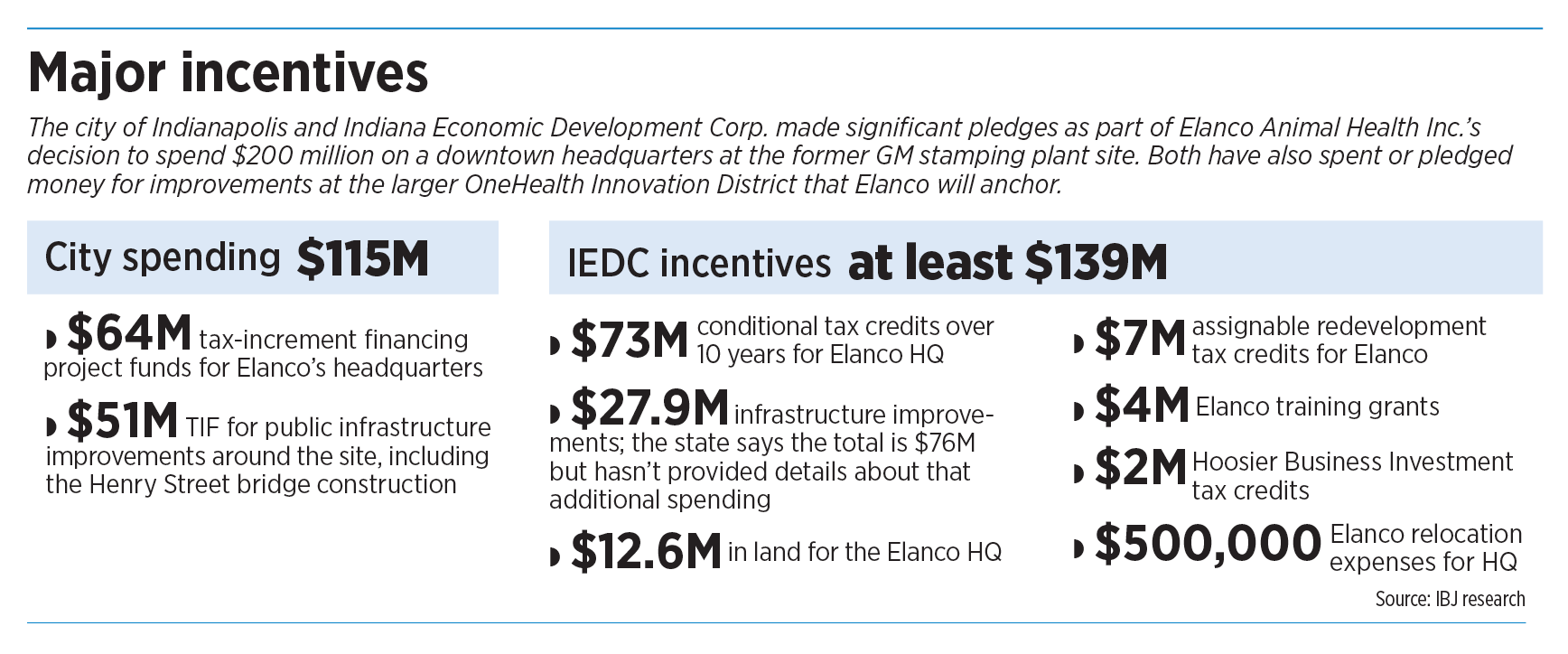
After the IEDC bought the property, it spent at least $76 million on infrastructure, concrete removal, re-platting the site, adding roads and sidewalks and marketing the property.
The city of Indianapolis has also contributed to the OneHealth project, pledging $64 million in tax-increment financing for the site and earmarking $51 million for other infrastructure, including $43 million to build a bridge over the White River at Henry Street. That bridge, which will connect the OneHealth site to the heart of downtown, is under construction.
Elanco paid $27 million to acquire the land around its new HQ building. Adams said that while the sale may appear on paper to be a financial loss for the state—given its initial investment in the property and later work on the site—the state felt the sale was “the best way to make sure that we’re getting the best return on investment for the citizens of Indiana.”
The price was based on an appraisal done by Lafayette-based Don R. Scheidt & Co. Inc., which specializes in real estate valuation.
‘A real opportunity’
Experts said the investments made by the state—and those being made by the city into the site and adjacent property—will make the site more marketable.
The state is also moving ahead with plans to expand White River State Park to land that was once part of the stamping plant site, including a historic crane bay used for manufacturing. That $65 million park project will cover 15 acres, with a first phase featuring an event space inside the crane bay structure, along with new greenspaces, a theater and a promenade overlooking the White River and downtown Indianapolis.
“This agreement is a responsible step forward,” Gov. Braun said in a written statement announcing the sale of the property to Elanco on Aug. 25. “It places this property in the hands of a company with a clear vision of a world-class innovation district, while ensuring the state of Indiana remains a full partner in what comes next. This is about more than redeveloping land; it’s about creating jobs, attracting talent, and driving long-term growth for Indiana.”
The Elanco deal followed nearly a year of trying to sell the site to potential “master developers” that could find users for different parcels and sell it off piece by piece—essentially the role that Elanco will now play.
The IEDC issued a request for proposals for the property in May 2024 without a price tag. In October, it rebranded the campus as Levee, a nod to the site’s proximity to the levee along the western bank of the White River and the word’s Latin root “levare,” which means “to lift up.”
It’s not clear whether Elanco plans to move forward with the Levee branding or the site plan proposed by the IEDC.
The state plans to remain a partner in the OneHealth effort. But Adams said Elanco will be able to leverage its industry connections to find potential users.
“This is where I think the partnerships where we are working with existing companies really come to play,” Adams said. “We can be much more strategic about the kinds of opportunities that make sense for the state.”
He said Elanco, Purdue and the state will work together to develop the site as an extension of downtown Indianapolis, helping bridge the White River through additional development activity and a stronger focus on creating a life sciences district akin to what’s been done in Silicon Valley with technology and in Boston with biopharmaceuticals.
“This a meaningful moment for us, and one that I think presents a real opportunity for us to intentionally and proactively focus on this development,” Adams said. “I’m not talking about physical real estate. I’m talking about the development of the One Health and life sciences ecosystem here in Indianapolis.”
Purdue University’s involvement could also play a hand in the transformation of the site, because the university plans to co-locate research facilities within the campus, including those focused on veterinary sciences and other associated disciplines, as part of the OneHealth district.
But animal health won’t be the only area of study that Purdue will undertake. The OneHealth district is among the university’s biggest priorities, with a goal of uncovering breakthroughs in human and animal health, diseases and food, among other areas.
Dan DeLaurentis, executive vice president for research at Purdue, said he expects that the land purchase will bring modifications to the plans announced last year, including the development of a building on a 3-acre site through a partnership with Elanco,
He said while no decisions have been made about the specific presence the school will have at the district, the launch of Elanco’s ownership “is a time to actually reexamine some of the ideas or constructs that may have been explored in the past but not be tied to them.”
Isaac Bamgbose, founder and CEO of New City Development, said he thinks Purdue’s involvement will go a long way, but he also said that the district is well-positioned for future development because of the presence of Elanco’s headquarters.
“The beauty of a site like that is we now have hundreds of employees going there every day,” he said during IBJ’s Commercial Real Estate and Construction Power Breakfast on Aug. 27. “One of the big things with mixed-use development is that people want the opportunity to gather, they want the opportunity to be able to feel that energy that creates flourishing. … That’s an example of a place where there’s a lot of great opportunity.”
For Culp, the economic development expert at KSM, having Elanco in the driver’s seat means that there will likely be a clearer vision for the property—and the ability to move faster on development deals.
“In general, it’s my belief that the private sector is more efficient than the public sector, especially when it comes to real estate transactions,” she said. “It’s nothing specific to the city of Indianapolis … and not necessarily even Indiana, but when you have public sites that are set to be developed—they’re not developers, they’re government. And so I think the process typically takes longer. I just feel like [Elanco can be] more nimble to create a campus that is thematically consistent with what they’re doing there already.”