
A potential $1 billion data center project in Clinton County is moving forward following a planning meeting that touched on everything from taxes to drainage infrastructure to the area’s agricultural heritage.
At the end of the meeting, property developer Logistix Realty received a “no recommendation” from plan officials as the company’s proposal now moves to the county commissioners.
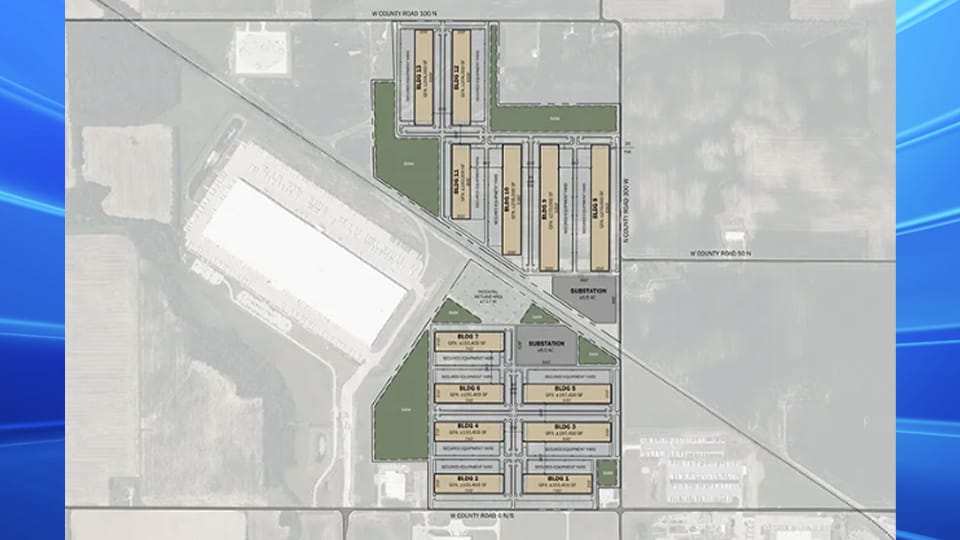
Logistix is dubbing its project the Logix I campus and seeks to build on 155 acres just northwest of Frankfort. The land is currently zoned as agricultural, but Logistix is requesting it be changed to light industrial.
Logistix President Doug Swain sought to assure members of the community during the meeting as he emphasized the data center would bring no pollution, use “nominal” amounts of water and produce noise levels consistent with a normal speaking voice.
He said an end user for the data center would hire around 170 full time employees and could generate $265 million in property tax revenue over 25 years. That income could be vital to the region as Senate Enrolled Act 1 depletes local budgets, Swain argued.
“This area is in a TIF district, giving the county control of the money from the property taxes generated here,” Swain told area plan commissioners. “That money could be … used to fund things that would incentivize home developers, apartment developers which will be desperately needed to make up for the tax changes.”
Plan commissioners had trouble coming to a consensus on the rezoning proposal. After multiple unsuccessful attempts to postpone the request or give it an unfavorable recommendation, the board ultimately voted to give the measure no recommendation as it heads to the county commissioners.
Commission members, including Kevin Myers, who is also one of Clinton County’s three commissioners, said they’re hesitant about the project.
“This meeting tonight is something that should have occurred three months ago so we could all make informed decisions and weigh the options,” Myers said. “There’s too many unanswered questions that I don’t feel like I could be in favor of anything but a negative recommendation.”
Final rezoning approval goes before the county commissioners who meet next on Sept. 16.
Logix I campus
Logistix’s zoning request—technically made through a subsidiary called Logix—represents a scaled-back version of the company’s original plan.
The Cincinnati-based developer first told Inside INdiana Business in July of plans for a 700-plus acre campus that would benefit from the I-65 corridor and proximity to both Purdue University and the LEAP Innovation and Research District in Lebanon.
Logistix originally wanted to annex the project site into the city of Frankfort. Now Swain is pivoting to a campus on just 155 acres, all in Clinton County to simplify the process.
The newly focused site is on the northwest corner of Frankfort, technically in Clinton County. The site is directly northeast across the railroad tracks from the Conagra facility and is bounded to the north by County Road 100 and to the east by County Road 300 West.
The projected 170 jobs and $1 billion in projected investment are down from Logistix’s original vision of $10 billion worth of investment with 350 full-time jobs.
Swain did not say if Logistix has reached an agreement with a company to operate the data center. He said his company hasn’t filed for any local tax abatements, but an end user likely would.
An extensive report from the county’s area plan director Elizabeth Stitzel discussed multiple technical issues Logistix has yet to address, but highlighted the site’s suitability for industrial zoning.
The site has drainage issues, and Stitzel said County Road 100 North is a small gravel road that would need to be improved before any large-scale construction. She said Logistix did not address either item in their rezoning application.
But, Stitzel said the site has good access to sewer, water and electric lines, and it’s adjacent to other industrial plants like the Conagra and Frito Lay facilities, as well as a railroad.
“Given the adjacent industrial park, it’s hard to argue farming is the highest and best use,” Stitzel said. “Sooner or later, it is likely that some industrial or heavy commercial development is the best use for this land.”
Most of the over 100 people who attended the meeting disagreed. More than a dozen residents spoke at the meeting about fears over noise and light pollution. Water usage was a main concern, while others strongly opposed tax credits for the project.
Plan commission president Grant Mohler recused himself from the vote citing a personal conflict of interest. Jeff Chynoweth was the lone plan commission member to vote against a negative recommendation, leading to an impasse that resolved itself in a vote for “no recommendation.”
“For some people…it doesn’t matter what comes to that property or that industrial park, they’re going to say no to it,” Chynoweth said, which sparked a series of boos from the crowd. “You’ve heard the comprehensive plan here. One day it’s going to grow.”