
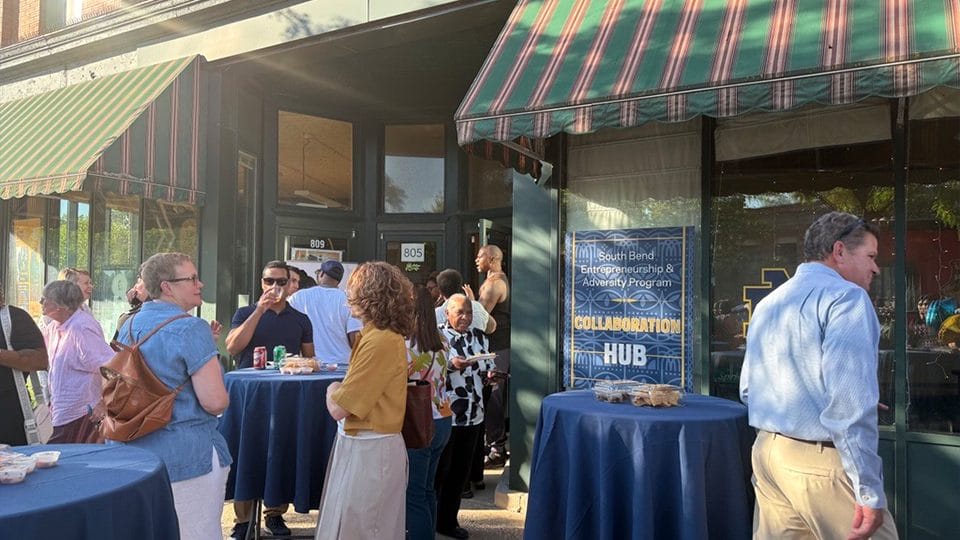
The Collaboration Hub, a local resource for entrepreneurs in South Bend, celebrated its first anniversary Tuesday, highlighting the role it has played in helping local business owners sustain and grow their endeavors.
The facility was created to provide ongoing support for graduates of the South Bend Entrepreneurship and Adversity Program (SBEAP). Founded in 2019, SBEAP takes in about 70 entrepreneurs each year, with more than 100 others currently on the waitlist.
The 10-month program offers training, mentoring and student consulting, aiming not only to help participants launch businesses but also achieve financial sustainability. More than 80% of participants have been able to get ventures up and running, with roughly a third reaching stable footing.
Program founder Michael Morris said many graduates faced challenges that required more long-term resources. That realization led to the launch of the Collaboration Hub last year, designed as a base for entrepreneurs to find guidance, space and resources to build on what they learned.
“We made an assumption when we launched that this program would get these ventures to a point where the local ecosystem would take over and help them the way they help other ventures,” Morris said. “But that hasn’t happened the way we would have liked to see it happen. The Collaboration Hub was born out of that.”
Morris speaks about why it was necessary to launch The Collaboration Hub
The hub offers consulting, workshops and specialized resources such as an AI station, access to the University of Notre Dame’s Hesburgh Library databases and targeted training on platforms like QuickBooks and Canva.
Notre Dame students also play a major role in keeping the program running. About 40 volunteers provide support each wee,k and unlike many campus programs that close during breaks, the hub stays open year-round with morning and evening hours tailored to entrepreneurs’ schedules.
In its first year, the hub recorded more than 3,900 hours of consulting, delivered tailored solutions to 107 entrepreneurs, hosted 38 training sessions attended by more than 350 people, and produced 255 business deliverables. The program also supported the launch of 40 new businesses and helped 20 others reach financial sustainability, Morris said.
“What we’re trying to achieve at the hub is a place for mutual benefit,” he added. “It’s not about what we can do for these entrepreneurs, it’s what they can do for each other.”
The hub’s anniversary drew partners and community members who emphasized its role in connecting Notre Dame with the region. Mary Gallagher, dean of the Keough School of Global Affairs, said the program aligns directly with the school’s mission.
“Our mission at the Keough School is to promote integral human development,” Gallagher said. “We want to promote development that helps the lives of real people and this Hub is definitely doing that.”
Gallagher mused about the prevailing societal conversations around artificial intelligence and the future of work.
“Everybody is worried about AI, but this kind of experiential learning cannot be replaced by AI,” she noted. “This is real human interaction and real learning based on people’s real experiences and students helping them navigate often complex problems that we know AI is not good at doing.”
City officials also commended the impact of the hub on South Bend’s near west side. Mayor James Mueller said entrepreneurship is central to the community’s future and praised the partnership between the university and local organizations.
“Our goal as a city is to make sure that this is a place of opportunity and a place where everyone can thrive,” Mueller said. “We’re going to continue to make entrepreneurship and these programs essential.”
For entrepreneurs, the hub has offered a lifeline of support. Laquisha Jackson, owner of Soulful Kitchen, who has grown her business with help from the program, said it allowed her to focus on growth instead of carrying every responsibility alone.
“Usually when you’re an entrepreneur, you’re everything in your business,” Jackson said. “One thing about the hub is you don’t have to be everything in your business. They have resources here to help you with whatever you need.”
Jackson also gave future entrepreneurs a piece of advice, encouraging them to seek growth rather than comfort and to approach the hub as a place to stretch their potential.
“When you come through the hub, we’re coming in here as leaders. It’s also our responsibility to continue to elevate,” Jackson said. “So we have to have a growth mindset when we come here. We’re not here for a handout; we’re here to go up.”
Other entrepreneurs echoed the importance of the hub’s ongoing coaching. Tiffany Reddick, founder of Elevate Youth Mentoring, said the guidance she has received helped her refine her business message and strategy.
“Even though I’ve taught entrepreneurship, I still need coaching. I still need someone to brainstorm with and throw ideas off of a lot of times,” Reddick said. “This is a very useful resource. I would recommend it to anyone that wants to come out and get assistance.”
Community partners praised the hub for creating an exchange of knowledge between the university and local neighborhoods.
“The entrepreneur program is just what I feel Notre Dame ought to be doing, linking with the community,” said community organizer Gladys Muhammed. “The students, learning from the neighborhood and the neighborhood, learning from the students.”
The program has also been transformative for students who dedicate their time to consulting. Notre Dame junior Quinn Littlefield said the opportunity has been the highlight of his time as a student.
“I think of the hub as the most important and valuable aspect of my college experience,” Littlefield said. “We have a group of so many talented entrepreneurs who experience difficulty but also show grit and really have that growth mindset.”
Tim Sexton, associate vice president for public affairs at the University of Notre Dame, said the Collaboration Hub is one of the programs that would eventually be housed in the university’s Tech and Talent Hub. The program aims to start 200 new ventures in the next five years.