
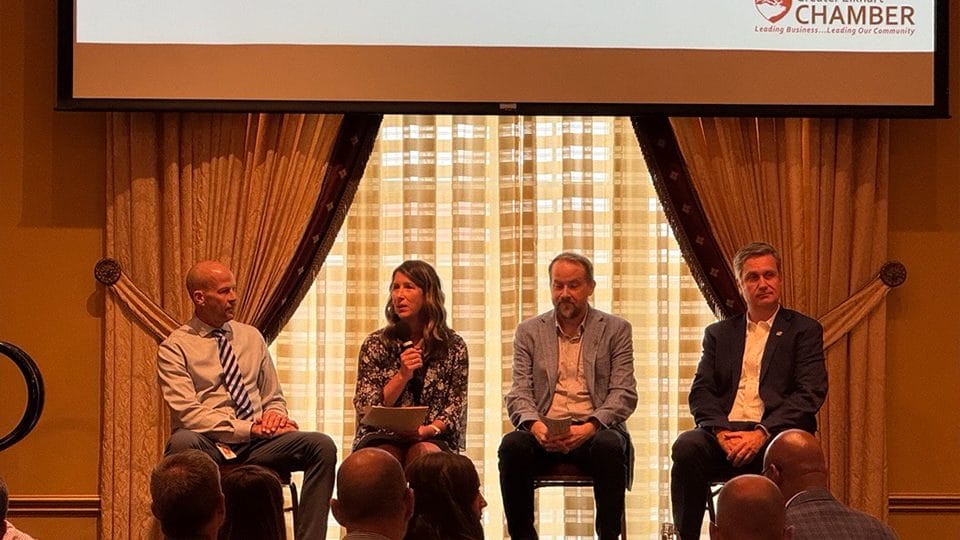
At the 2025 Annual Greater Elkhart Chamber of Commerce Economic Update this week, education leaders stressed the need for deeper collaboration between schools, colleges and local businesses to prepare students for the rapidly changing workforce.
Underscoring the urgency of aligning training programs with high-demand careers, Patrick Englert, chancellor of Ivy Tech South Bend-Elkhart, said new data from a study in partnership with the Lilly Foundation revealed shocking numbers.
“Eighty-two thousand individuals will need reskilling, upskilling, year over year,” Englert said. “That is a staggering number to think about addressing in the state of Indiana.”
He said Ivy Tech is trying to meet that demand by embedding career development into programs and partnering with industry to identify “credentials of value.”
Sarah Koontz, director of CareerWise Elkhart County, said her program is helping businesses adapt through youth apprenticeships that begin in high school.
“The stories our youth apprentices tell are transformative,” Koontz said. “They change businesses, not just by filling jobs but by reshaping workplace culture.”
She emphasized that apprenticeships differ from internships. Unlike internships, the apprenticeships last two to three years, beginning in a student’s junior year and span industries such as law, business operations, manufacturing, culinary and health care. Koontz said many companies are new to the idea of using youth to fill workforce gaps but student interest is strong, with more than 200 applying for about 80 available slots.
Brandon Eakins, director of the Elkhart Area Career Center, emphasized how recent changes to Indiana’s high school diploma requirements will increase the demand for career exposure, work-based learning and employer engagement. He said the new system’s “seals,” which replace traditional honors diplomas, require students to demonstrate employable skills and experiences.
Eakins explains the need for corporate involvement is fulfilling the new Indiana high school diploma requirements.
“If we don’t have conversations as an entire community, we’re never going to be able to fulfill the students we serve,” he said. “So as a community, we need to create memorable opportunities that bring that talent back to our region after they graduate from our K-12 system.”
Eakins said many students know the products local companies make but have little understanding of how those organizations operate or the career opportunities inside them. He added that building relationships between schools and businesses early is critical.
“There is definitely something that your organization can provide in that K-12 continuum. Students, like many of us, develop relationships from interactions,” Eakins said. “If employers aren’t engaged until the point of work-based learning, that’s not setting our students up for success.”
Panelists agreed that while technical skills are critical, employers are equally concerned about soft skills such as communication, punctuality and problem-solving. Programs at Ivy Tech, the Career Center and CareerWise all now embed soft skill development into their offerings.
Englert pointed to Ivy Tech’s health care academy, launched with grant funding this summer, as a model for building career pipelines. The program gave high school students hands-on exposure to fields such as nursing and respiratory therapy, along with course credit and financial support. Ivy Tech is exploring similar academies in manufacturing and other sectors.
Eakins described large-scale engagement efforts at the Career Center, including employability panels, an annual career fair and mock interviews with more than 200 employer partners. He said these events give students resume-building experiences while providing businesses direct access to future talent.
The trio noted that workforce challenges in Elkhart County cannot be solved in isolation and called for increased partnership among stakeholders.
“We can’t wait three years to respond to industry needs,” Englert said, echoing sentiments from one of Ivy Tech’s workforce partners. “If we do, we won’t have a workforce.”