
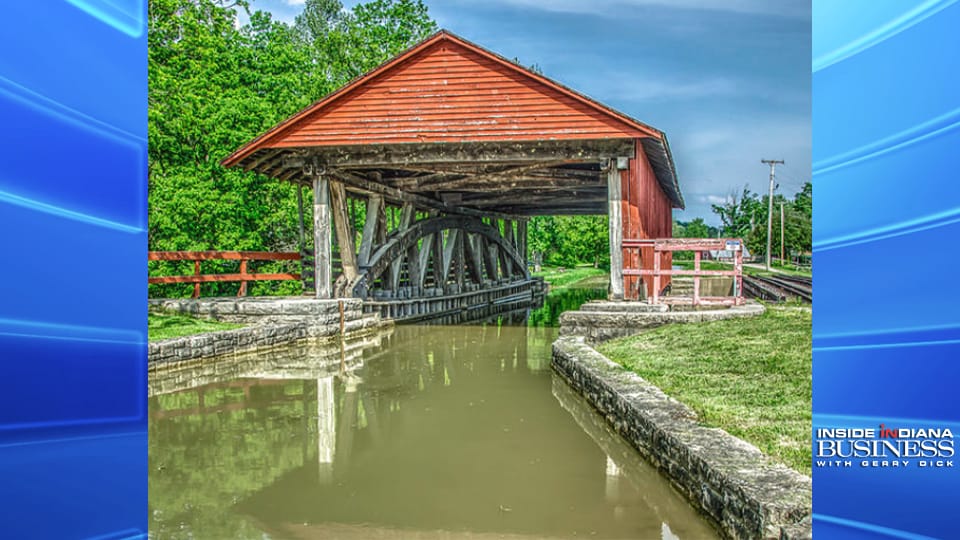
Often billed as Indiana’s Canal Town, Metamora boasts a strong tourism pull with its historic grist mill and covered aqueduct that takes visitors back to an era before railroads.
A grouping of a dozen or so stores line the town’s Main Street selling sweets, trinkets and more catering to thousands of yearly visitors who come to see the only surviving and operational wooden aqueduct in the country.
The bucolic community has survived trying times, like when the Whitewater Canal gave way to the railroad as the main form of transportation in the region in the 1870s.
Metamora now faces a new challenge as the Indiana State Museum and Historic Sites—which operates the mill and aqueduct—recently announced it is closing the Whitewater Canal State Historic Site at the end of the fall.
The museum points to the high cost of repair work needed to keep the site up and running, but its decision to close the historic canal appears to be a consequence of Gov. Mike Braun’s quest to reduce state spending.
Just this month, the museum laid off 8% of its staff as Braun, and Indiana’s legislature cut 5% from most state agencies amid serious budget shortfalls.
“After exhausting all avenues to raise the funds to make essential repairs, it is no longer economically or environmentally feasible to continue to operate and manage the site,” the museum said in a written statement. “ISMHS will begin the process of determining next steps for the future of Whitewater Canal State Historic Site and will present the board with recommendations in September.”
The sudden announcement from the museum raises serious concerns in Franklin County as elected officials and business owners alike wonder what the future of the Whitewater Canal site holds and whether visitors will keep coming.
“My reaction was ‘Oh my god’, that type of thing,” said Franklin County Economic Development Commissioner John Palmer. “Especially since there had been discussions and planning for trying to get funds to do some repairs on the canal itself. But then to find that, out of the blue, the group that’s responsible for running it says, ‘We’re going to close it because of a lack of funds,’ was kind of a shock to say the least.”
Palmer and other business leaders in Metamora say they’re now looking at ways to raise money to keep the historic site operating or potentially transfer stewardship away from the museum.
Canal daze
While it’s hard to put a precise dollar figure on the impact of the Whitewater Canal State Historic Site, it’s clear that the historic elements of Metamora are vital to its tourism.
ISMHS data says just over 10,600 people visited the Whitewater Canal State Historic Site in the 2024 fiscal year. The biggest annual draw is Canal Days—traditionally held the first weekend in October—where thousands flock to the town for food and artisanal craft vendors.
“The businesses in Metamora are all tourism-related. And they are all there because of that canal. With that disappearing, that is going to hurt their business,” Palmer said.
However, business owners in the town don’t seem to think the sky is falling just yet.
Karen Smith has operated the Metamora Inn since 2021 and feels that the town’s own tourism groups and community organizations play a large role in bringing in visitors. That includes the Canal Days, various festivals and holiday-themed events, which are run by the local Historic Metamora Inc. group—not the Indiana State Museum.
“Metamora has a unique hybrid situation with the state museum being there and this business district we’ve built up over the years,” Karen Smith said. “The canal will still be full of water, the park will still be there, people can still walk by it. We’re still kind of trying to weigh what the impact of the state museum leaving will be.”
Karen Smith’s husband, Bill Smith, also owns a business in town as he operates the Village Smith shop. He’s the president of the Duck Creek Crossing Association that represents a number of businesses in the area.
While Bill Smith is indignant about the lack of warning given to those in Franklin County about the closure, he pointed out that much of Metamora’s tourism comes around the holidays after the historic site itself closes for the season. In the short term, the announcement doesn’t affect the town’s rhythm.
“Our busiest time of the year by far is October through December and most of that time the grist mill stays closed,” he said.
Preserving Metamora’s past
To Franklin County leaders, the state’s announcement just adds more urgency to the ongoing task of maintaining the canal site for future generations.
The museum says it will take $14.4 million to repair and preserve the canal site including work around the aqueduct and lock systems. The museum and local lawmakers have made repeated requests to the legislature for funding until the state finally appropriated $7 million in the 2024-25 budget.
However, to access any of those funds, the legislature required a full local match which has proved to be a heavy lift for the small community.
According to Palmer and Bill Smith, the goal was for the museum to apply for $7 million from Lilly Endowment Inc.’s arts and blight elimination donation that’s attached to the Regional Economic Acceleration and Development Initiative (READI) 2.0 initiative.
As of Monday, Palmer said the parties are still waiting to see if the READI funds will come through, leading to surprise when the museum announced it would simply no longer run the historic site.
Now, conversations in Franklin County have shifted to figuring out how to maintain the historic grist mill and aqueduct if the state won’t. Palmer and Bill Smith declined to get into specifics, but options include joining under the umbrella of a different nonprofit, forming a new organization dedicated to the canal site or convincing the museum to change course and keep operating the site in Metamora.
“[The ISMHS] had made the commitment they would maintain the canal and its entities. That’s an obligation they have. If they’re going to shirk that obligation, they need to find a positive solution to how it will continue. And there are numerous possibilities and that’s what we’re in the middle of discussing right now,” Bill Smith said.
The Indiana State Museum and Historic Sites is a nonprofit organization that has received state funding and some oversight since 2011. It’s currently organized as part of the Department of Energy and Natural Resources.
The museum’s director of communication, Carla Knapp, said the organization’s board of directors “will work with the governor’s office and multiple agencies within state government to determine next steps for the Whitewater Canal State Historic Site.”
The museum is expected to give its board a recommendation in September.