
Food trucks are on the rise in St. Joseph County, driven by changing regulations, expanding economic opportunities and shifting consumer tastes. But the road to success has been far from smooth, according to vendors and officials navigating the evolving mobile food landscape.
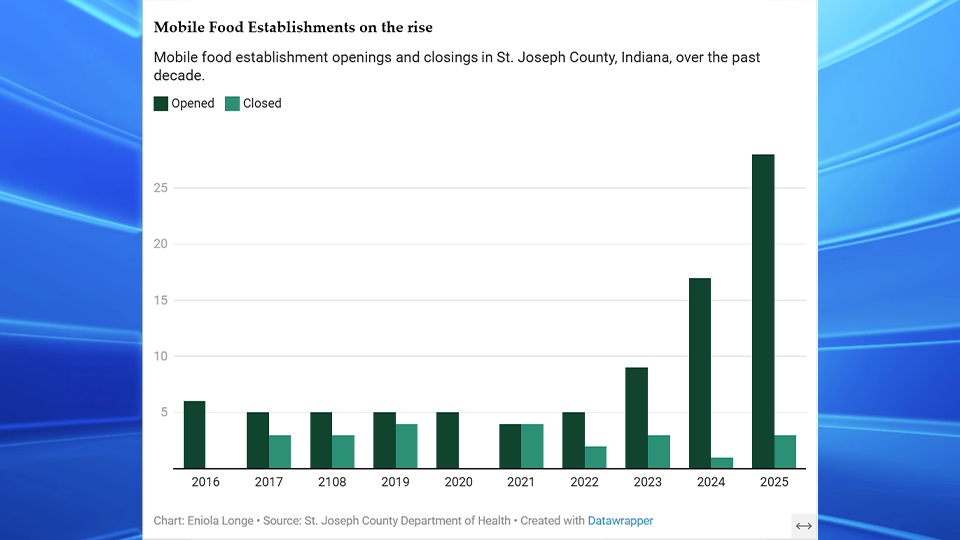
St. Joseph County Health Department data shows a notable increase in mobile food permits this year, spurred in part by a significant fee reduction.
Carolyn Smith, food service director for the St. Joseph County Department of Health, said the number of mobile retail food permits surged recently, with 59 permits already issued since January. The department lowered fees from as much as $375 to a flat $200.
“With the change in the fees that became effective as of January 1, we have seen a lot more people looking to get a permit,” Smith said. “Now that it’s more affordable, we’re seeing more interest.”
Smith talks about how the food truck landscape in St. Joseph County has evolved over the past decade.
Still, while the number of food trucks is growing, so are the logistical and financial demands on their owners. Since 2016, there have been a total of 89 food trucks permitted in the county, health department data shows. A 2015 ordinance change allowing food trucks operate in downtown South Bend led to more mobile food establishments popping up in the area, Smith noted.
Jairo Aleman and Robyn Klingerman, the owners of A Bite With Mee, bought a food truck after years in catering, only to discover a maze of county-specific regulations.
“Each county needs a whole other very extensive 30-page application,” they said, expressing frustration with the lack of statewide uniformity. “Having to do everything county by county is a pain for us in Indiana.”
That patchwork system may soon improve. A new law authored by Rep. Joanna King, R-Middlebury, and signed into law by Gov. Mike Braun this year establishes a statewide food truck permit system in Indiana.
House Enrolled Act 1577 is expected to simplify operations by allowing mobile vendors to apply once and operate statewide. To give the Indiana State Department of Health time to figure out the mechanics, the law is scheduled to go into effect in January 2027.
For many owners, the economics of food trucking remain precarious. “We’re still trying to figure out how to be profitable,” Klingerman admitted, citing the higher costs of locally sourced and organic ingredients. “People’s pockets are tight right now.”
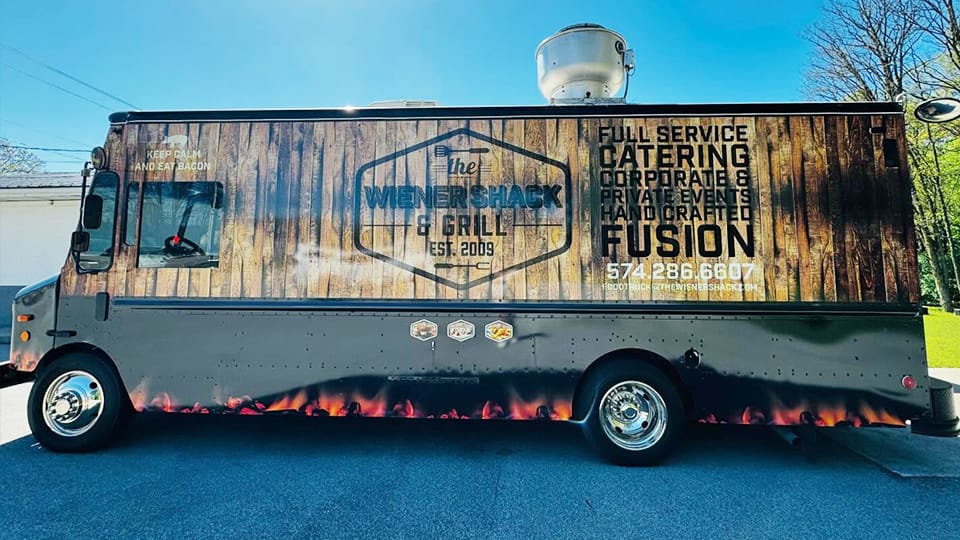
Doug and Jacqueline Murray, who run The Wiener Shack and Grill, have worked the food truck scene since 2014, after launching a hot dog stand following the 2008 recession. They are one of the oldest, still-functioning mobile food establishments in the area.
“We went from serving about 300 people to a couple thousand from the truck,” they said. But success didn’t come overnight. “We learned through trial and error. Small things just add up to big things in the long run.”
The Murrays have now shifted their business model from public events to focusing most of their time on catering clients. They said the guaranteed income from catering makes it a better choice than attending festivals or public events.
“We’ve had our trucks for over 11 years, and every year it just keeps growing. So it was a really good decision to buy the truck,” they said. “We still use the hot dog cart as much as we can because people still love us down in Goshen. So we try to be there at least one day a week, but we do 90% catering.”
The couple used Doug’s severance to pay for the business license, health department license, Serve Safe certification, street vendor permit and a New York-style hot dog cart. They quickly hit it off on the corner of Lincoln and Main in Goshen but then mimicking competition came along, they said.
“Many hot dog carts were popping up left and right at this point … and eventually many were copying our layout and menu items at least as close as they could,” Jacquline said. “So the menu items had to be elevated. More creative fare was implemented and is in part the key component in our survival as a business.”
Along with leveraging skills from previous employment and researching the hot dog business scene, the Murrays began to connect with their community in ways they had not expected. Becoming a part of graduation parties, corporate events and being one of the early participants in Goshen’s First Fridays event.
They have adapted to the Midwest’s harsh winters with practical solutions like draining water tanks and keeping heaters near plumbing. Other vendors, like A Bite With Mee, have learned similar lessons the hard way.
“You cannot use the truck in freezing weather because the tank can bust,” Robyn and Jairo said. “That was an expensive mistake.”
The requirement for commissary kitchens, state-inspected facilities for food prep and storage continues to be a surprise and obstacle for new vendors.
“That comes as a surprise to some people,” said Alan Steele, regional director of the North Central Indiana Small Business Development Center. “But some trucks are doing really well, especially those tied to brick-and-mortar restaurants.”
Smith noted that there is also a shortage of commissary kitchens in the county, often making it tough for these business owners to find a base of operation in a timely manner.
Some entrepreneurs, like Mary-Lue Proser of Mummy Lue African Food, are still trying to get their wheels on the road. Proser currently works from a commercial kitchen and is fundraising for a food truck. She said the mobility that food trucks offer will help to share her West African culture with a wider audience.
“Many of my customers asked for a food truck so I can get to them. People were traveling from Warsaw, Indiana, Michigan, a couple hours away from my food,” she said. “Giving them that satisfaction, where I can bring the food to them will be a nice thing.”
Smith noted the food truck model is increasingly being used to serve specific sites, like the Amazon Web Services data center construction project near New Carlisle. “At least three or four trucks have been launched to cater to that workforce,” she said.
According to Katherine Boyarsky, a contributor on Toast, the national food truck trend mirrors what’s happening in Indiana. Post-pandemic resilience, rising demand for convenience and shifts toward niche cuisines have kept the industry dynamic.
Despite the headwinds, food truck owners in St. Joseph County continues to innovate, driven by passion, necessity and community.