
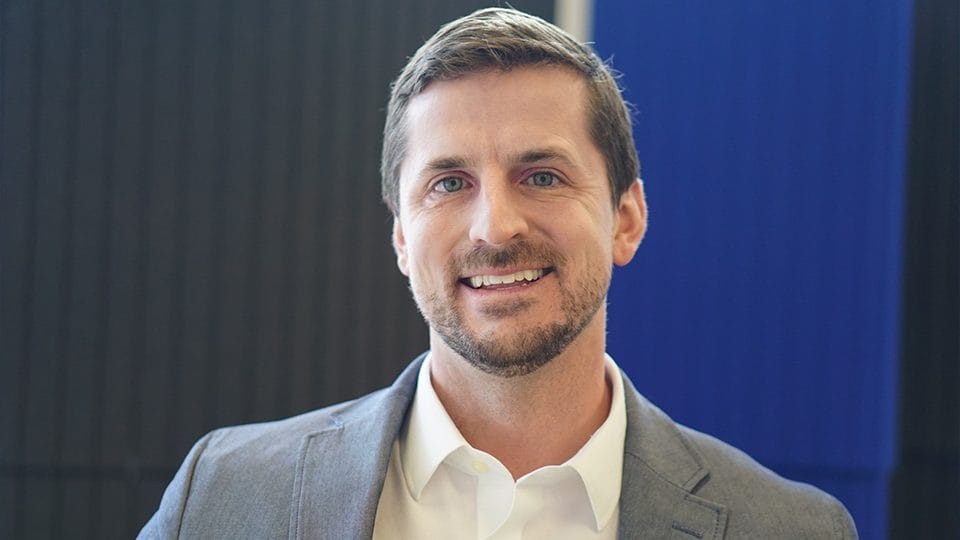
Transforming the fan engagement landscape for live entertainment events is at the core of South Bend-based Juke’s mission. Launched in 2021 by a group of University of Notre Dame alumni, the company got its start after winning the McCloskey New Venture Competition. So far, the company has raised $1.2 million.
The music-powered, data-driven fan engagement platform provides artists, fans and event organizers a fresh outlook on enhanced audience participation. But more than song requests, the web application also provides artists and organizers with back-end data that would usually be lost.
Inside INdiana Business spoke with founder and CEO Griffin Eaton on what sparked the idea for Juke, how the company has evolved and what he has learned along the way.
This article has been edited for brevity and clarity.
What gap in the industry inspired you to create Juke?
The inspiration was two fold. Many years ago, I was working with Anheuser-Busch, and we would sponsor artists and musicians to put on special shows for our customers. They were really interactive and people could request songs. They were some of the best live shows I’d ever been to. Then one day, I’m sitting at a brewery in the South Bend region, and an artist was playing and I really wanted to request a song. But I didn’t have any cash, I didn’t know what he could play and it would have been awkward to walk up to him. So I began to wonder if a digital jukebox for live music existed.
Then I learned there were other people like me, fans, who wanted to be able to request songs and follow them afterwards. Then on the other side of things, I started talking to artists. It’s really difficult for an artist to make a livable wage and build a fan base, so it seemed like there was a natural opportunity for light software to sit in between the artist and the audience.
Can you explain how Juke works?
It’s a web app that connects artists, venues, fans and teams. Broadly speaking, we’ve become a fan engagement platform that was first built for the live music scenario, but has since gotten into sports. Regardless of the environment, curating fan experiences at a really high level is the goal. Before the event, whether it’s an email or on social media, you’re able to see how a performer or team is inviting you to be part of the show or game. If you’re at the venue, you can scan a QR code that takes you to a menu of all the ways you can be part of the event. Afterwards, the performer receives revenue, emails, or both, of everybody who participated in the audience.
We’ve got a few different revenue models, depending on who the customer is. For small artists, it’s free to join and then there’s a revenue share. If fans are requesting songs and tipping, there’s a small portion that we’ll take, and the rest goes to them because we don’t want to have a subscription for an up-and-coming small artist. We want to grow their pie and grow their revenue, as opposed to taking from it. We also work with sports teams and larger touring acts, where we have a whole other set of features; for that, we basically do a split of software license fee and potentially revenue share.
Was there a defining moment when you realized that you had built something that could potentially be game changing?
We’re still pushing the rock uphill and hoping that’ll be the case. The best signal we’ve had for that is our Live Nation collaboration. We just did our first Live Nation tour with 67 shows throughout their footprint of venues: Red Rocks, Jones Beach and some pretty iconic venues. They’ve been putting on these big shows for 25 years, and they said that the experience that we offered them basically completely changed their show. That was a pretty big moment, probably my favorite.
For smaller artists, they’re making five to 10 times more in a show, which is significant if you’re a small career artist. Now we’re figuring out how to get this product into the hands of many more small career artists.
What role has technology played in shaping your company’s success?
Just the ubiquity of everybody having a cell phone, having good WiFi in big stadiums, or at least good cell service has really unlocked the potential. You couldn’t do this five, 10 years ago. We’ve also been using a lot of AI tools to make us more efficient internally. With AI we can bring even more value to artists, teams and fans. We can do some things that are a little more fun. Fun is underrated, and so we’re just here to try to even amplify it even more. Our future road map allows us to do some things that are pretty exciting.
What does your team look like and how has the team grown since you launched?
We’ve been pretty lean the whole time. I joined a venture studio out of Silicon Valley, run by Tim Connors and Jeremy Burton. Tim has big ties to the region and Notre Dame; that’s why I bring him up. Initially, our team was essentially myself and one or two other folks, and then this army of folks at the venture studio, whether it was social media or engineering or design. We graduated from there six months ago, and so now we’ve got our engineer, local to South Bend, our customer relations person, local to South Bend, and then myself, I bounce between South Bend and Nashville. Then we’ve got a whole suite of advisors that are experts, either in sports or music.
Has being based in South Bend offered the company any competitive advantages?
I certainly wouldn’t have been able to do this out in any other area when I launched the company. There were artists here that were eager to work with us on our alpha and beta product, same with the venues. My network and the folks that I knew in the area were eager to support, so funding was shockingly easy. Then we won Notre Dame’s business plan competition and that was really important for connecting with the venture studio and Tim. There is a nice community of other founders here. Our office is at the IDEA Center, so being around other folks who are also starting companies was really important. So South Bend and the whole ecosystem was pivotal.
Then I bounced to Nashville. Because of the industry I’m in, it’s really great to have the network and start building relationships there. But South Bend won’t go away. The South Bend-Elkhart region more broadly has been a spot where we can innovate and it’s just fantastic.
Eaton speaks about how being in South Bend nurtured his dream for Juke.
Since you launched, what has been your biggest lesson in entrepreneurship?
The one that strikes me first, particularly in the beginning stages—don’t be precious with the idea. I was telling anyone and everyone about the idea for Juke. As I started taking tangible steps, I was just sharing the story of what I was doing to anyone who would listen. Broadly speaking, that got me employees, investors, customers or introductions. It really helped grow and launch the company.
Jeremy, at the venture studio, would always say ideas are a dime a dozen, and it comes down to execution. So the benefit of talking about the idea outweighed the risk of someone stealing the idea.
Do you have any advice for aspiring entrepreneurs?
Just do it. Spend more time doing stuff than planning. You can plan a little, you can think about competition, you can think about all that stuff, but my experience was just always taking that next step. For instance, I had this thought that it’d be cool to request songs, and I talked to a bunch of other people who listened to live music to see if that’s a feature they’d be interested in. Then I talked to 10 artists, and I just kept being convinced at each step that it was worth taking the next one. I did a quick Google search to see if something like this existed, and once I saw it didn’t exist, I just ran with it. There’s times when you’ve got to dive in and look at strategy, but broadly speaking, just doing anything is better than thinking or planning or building a deck.
How do you see Juke evolving over the next five years?
This past year, we finished just shy of $200K annual recurring revenue. We’re hoping to get to a million this year and then raise a seed round. At that point, we’d really start to look into scaling, figuring out our product-market fit. In five years, I’d like to be able to say that we’ve fundamentally changed the concert going experience. I’d like to think that we’ve made it a lot easier for up-and-coming artists to find their fans, find their super fans, have more control over that relationship and that data.
Juke found a natural entry point, which is the live show. That’s when an artist is in front of their audience and their potential customers. There’s a lot of similarities in sports, most athletes are also not making millions of dollars, most are in either college, high school, college or minor leagues. So understanding and developing that relationship with the fan is a real priority.